Looking for Russell Cushman art ?: http://russellcushmanart.blogspot.com/

Looking for BLUES HISTORY?
http://brazosvalleyblues.blogspot.com/

Looking for ARTS & ENTERTAINMENT?
http://brazosvalleyarts.blogspot.com/

Showing posts with label texas ranger. Show all posts

Sunday, March 26, 2017

THE CLYDE BARROW MIRROR

History and MYSTERY lovers, 
Former Texas Ranger Bob Connell
 and I talk about things we can't prove.
 It's a long list.
It's a charming, somewhat humble thing. And it has a wonderful story which requires some suspension of disbelief in order to fully enjoy it. It is an old engraved mirror, and if only it could reflect back to us what it has seen. 

The Barrow Mirror.

The other day I was chatting with a retired Texas Ranger, a man who would have many stories to tell if there was time to listen. Bob Connell was once the interim Police Chief in Navasota, and is not just a former Texas Ranger, he is a man who has spent his life collecting the legends and lore of his esteemed law enforcement agency. He is the proud owner of a rare Texas Ranger badge, once the property of Ranger Captain M. E. Bailey, that was dug up by a Navasota citizen in his flower bed. History randomly coughed up the brass relic of one former ranger and former Navasota City Marshal in 1912, into the hands of a man with the same relative titles one hundred years later! But that is another story.

And people have given him things.


The subject that day gravitated to “great stories we could not prove.” There are lots of them. The old badge had Bailey's name inscribed right on it, no problem proving that. But time and circumstances have erased the traces of provenance that have reduced otherwise sensational things... into the seemingly ordinary. And Bob has one such frustrating item.


The story goes that he had an uncle named Audie who lived in Dallas, and Audie once worked as an ice delivery man. Yes, once men delivered big blocks of ice to homes, back in the 1920's, '30's and '40's. The people would put a little placard out in the window or on the porch if they needed ice. The delivery man would stop his wagon or truck and bring it right to the doorstep with a pair of giant tongs. People kept their blocks of ice in ice boxes. They would use it to cool their perishable food, and would chip or shave ice off the melting ice block for drinks. Everybody had an ice shaver and an ice pick in the kitchen drawer. 

Anyway, one of Uncle Audie's customers was Mrs. Cummie Barrow, faithful mother of the notorious Texas gangster and cop-killer, Clyde Barrow. One day, for some reason, perhaps to pay her ice bill, Mrs. Barrow offered Bob's uncle a little treasure in lieu of payment for her ice service. She had this old mirror... and the story goes it had been given to her from her infamous and bereaved son Clyde. And Audie the ice man took the mirror and kept it. We are going to assume he took care of her ice bill, in trade for the mysterious relic. 

 
The story goes... that young Clyde, before he turned to a life of crime, had worked at United Mirror & Glass Company at 2614 Swiss Ave., in Dallas, believed to be the very glass company where the mirror had been made, and Clyde quite possibly had helped in the manufacture of it... sometime between 1926 and 1930... as the story goes. One has to believe it would have been a serious sacrifice for Mrs. Barrow to part with such a useful keepsake. And one has to believe that this vintage mirror has no little significance in Texas law enforcement history... and considerable value to collectors, if the story could only be proven.


The mirror had been left to Ranger Connell's parents and thus to him. Now he owns the mirror and its story, and has done all he could as an experienced investigator, to establish the connection between the mirror and Clyde Barrow. Absolute proof is impossible. 

But belief is. It is, that is if you accept the oral traditions of a family that preserved not only the mirror and its story, but a Texas lawman with a stellar career.


Personally, I think it is good that Ranger Connell cannot prove his family's most controversial icon. If they could have, it might have been sold decades ago. The money would now be gone, the story lost to some packrat collector and never told or shared. The mirror would be hanging in some oilman's man cave, a casual conversation piece, always explained by, “yeah, I probably paid too much for that thing...”


It is because he cannot prove his story that Bob still has it and is still talking about it. It's probably the find of the century, that could be worth thousands. But is more valuable to all of us as a story. In the end, to me that kind of story is worth more than money. It captures the imagination where cold cash just lays there with no life, no mystery, no anticipation. 


 When I looked into the mirror for the first time, I saw (in my fertile imagination!) Bonnie and Clyde looking into it as well, and back at me. It gave me the creeps. It made me think about old lady Barrow tearfully handing over the thing to her ice man. For a second I was inside that glass... my reflection was sharing space above the silver with them all. 

How much is something like that worth? Well an old ranger and I think it is priceless!

Tuesday, January 5, 2016

THIS is OUR History! The COOLEST Stinkin' Badges!

Navasota, Texas is especially blessed with interesting history, and was at one time the home of an impressive array of Texans. And there are no more celebrated Texans than the members of the Texas Rangers, both real and artistically interpreted. Most towns the size of Navasota might be able to boast that they were the residence of a Ranger sometime in history, but Navasota can boast of at least five... and three of which we actually know of the exact badges they wore. This is unheard of. History yes... legends sure, in the books maybe.. but the actual stinkin' badges? Hardly ever!

Perhaps one of the oldest authenticated badges known in Texas Ranger history belongs to Dr David Fruchtman, an Arizona forensic scientist and criminal justice professor, who has recently shared a badge in his collection... with provenance, which was the Ranger badge belonging to the legendary western lawman,  Jeff Milton...

Milton was the adventurous son of the Florida Governor who came to Texas after the Civil War to live with his sister, who had married a Navasota merchant. He did not stay in Navasota long, and became a Texas Ranger when just 18, with the endorsement of Navasota attorney and former Attorney General of Texas, H. H. Boone. Milton's career with the Rangers was cut short after some tragic gunplay, and subsequent legal embarrassment to the Ranger organization... but he went on to become one of the most noted lawmen of the Old West. J. Evetts Haley wrote his biography in A Good Man With A Gun. You can read all about this Ranger's career at my blog below... just click on the LINK, after your read this!).
http://russellcushman.blogspot.com/2013/12/jeff-milton-from-in-law-to-outlaw-to-law.html

But you will not see his badge in the book... in fact you will not see it anywhere but right here!

There are several exciting things we learn from this badge. And some of what we learn challenges the conventional wisdom concerning these beloved icons of Western lore. First of all, we learn that at least some of them, HAD BADGES. The common belief is that they rarely had badges, and few Rangers ever wore them, as they were considered invitations to be murdered. Only on the force for a couple of years, Private Jeff Milton had this handmade star, with his company designation. This badge is crude, cut out of a disc of nickel, yet the lettering has been fairly masterfully done, with a popular zigzag technique, which is seen on many old badges. Unfortunately, the finding has been lost. On this badge, the wearer chose to inscribe RANGER, (singular)... not Ranger Force or State Rangers (plural). These details may seem insignificant, but they help establish what I have suspected... that is a total LACK of a pattern in the early badges. And just as importantly, it is not cut out of a Mexican Peso.

The exclusive use of etching on the badge suggests several things. Out west where the Rangers were ranging, and where they were most likely to try to scrounge up a badge of some sort... they had to settle for homemade badges, or ones made by frontier jewelers, who had very limited tools and materials. The right metal was scarce, and the tools necessary to work metals were usually not available. If a mistake was made in the cutting of it... like the chopped-up star in this badge, that was just too bad! There were few or no stamps available to hammer pretty letters into sheet metal.

So an engraver might have been the closest thing to a badge maker available. My guess is that another Ranger of Company B had this one made, and had a better one made when he could, and passed this faulty one on to the young Ranger... who did not need it long. It was soon just a keepsake for the young Floridian who wandered the west for years as he tried to grow up and get the respect he craved. Now the badge is a direct link to his life and times... and another intriguing link in our study of Texas Ranger badges.

Texas Ranger badges are rare. Let's just say so rare that I went most of my life collecting antiques and seeing hundreds if not thousands of fake Ranger badges being passed off and nobody ever expected to really find one... You would find diamonds in a diamond field faster than you would find a real OLD Texas Ranger badge in an antique market. Yet my neighbor dug one up in his yard, right here in Navasota. You can read that story (later!) here at this LINK:
http://russellcushman.blogspot.com/2012/09/a-texas-ranger-badge-makes-visit-to.html


The significance of this badge is hard to fully appreciate. It belonged to the Navasota City Marshal around 1911-1915. M. E. Bailey was a Ranger buddy of Frank Hamer's out in Alpine and came to help him in Navasota as his Deputy City Marshal. He took over as marshal when Hamer left Navasota. Hamer was a devoted fan of Bailey's and when interviewed after his death, claimed Bailey had once single-handedly arrested a handful of Mexican generals who were in Texas recruiting for Pancho Villa. What Captain Bailey could not have fully appreciated were the number of Texans who supported Villa and his revolution, and who made money off of the gun trade. This arrest made him a huge target, with enemies on both sides of the border, and this event may be why he left the Rangers and migrated around 1910 to civilization on the Brazos. Some way, some how this badge got dropped, thrown and buried in the flower bed of his residence in Navasota, to be dug up nearly a hundred years later, from dirt a foot deep.

The Bailey badge also teaches us several things about Texas Ranger badges. By 1910, some were being ordered and made by real honest-to-goodness badge manufacturers. Some were brass or bronze, thin, pressed by machine, and featured the ranger's name and rank and company. These were official but fairly cheap badges. This captain's badge suggests that even a ranking officer would have no more fancy a badge than any regular city lawman. But it also may be one-of-a-kind.

The only common denominator between most early ranger badges is the star inside of a circle. Several companies out west could have been contracted to do such work as shown in Bailey's badge... But my pick would be Anson Mills, who had a large operation with big money government contracts in El Paso. They manufactured a wide array of military issue belts and beautifully ornate, brass belt buckles... for several governments. Mills was a former Civil War Union General who came out west to make his fortune and did so. With his fame and connections and his handy geography, it is easy to imagine T. C. Orndorff, his brother-in-law who did much of the “heavy lifting” doing business with many regional law enforcement agencies. In fact there are photographs of Texas Rangers wearing his famous Anson Mills woven cartridge belts... sporting those beautiful buckles. Understanding the Mills'/Orndorff interest in the socio-political situation along the Texas border, it is easy to imagine that Mills made this badge (had his people make it) and gave it to the young Ranger for his daring-do... but probably the fancy brass badge only got to him after he left the force.

Bailey had moved on, probably despising the regime that forced him out because of divided loyalties... I can easily imagine it arriving in the mail one day while he was working in Navasota, and as he unwrapped it, cussing it and chunking it in disgust into the shrubbery outside his home... where it laid for a century.

The Texas Ranger badge worn by Ranger Frank Hamer.

Because of various auctions in the past decades, we have also gotten blurry peeks at the badges worn by Ranger Frank Hamer, before and after he served in Navasota. I have written extensively about Hamer on this blog, but we do not know what his City Marshal badge looked like, and in fact he might not have had one. He might easily have chosen to wear his Texas Ranger badge, which by then was a symbol of deadly authority. 


Recently I acquired a fantastic facsimile of Hamer's earliest Ranger badge, thought by his son and the auctioneers to have been made of brass or bronze. Few people have studied metals enough to know that really old silver, when not allowed to blacken from constant rubbing, will take on a deep yellow appearance. I have seen this most often on spurs, where the patina said brass but the polish revealed SILVER! Anyway I purchased this silver badge, which is the spitting image of Hamer's badge down to the scars. Possibly made by Langenbacher, the legendary badge copyist, it is unlike any other Ranger badge I have seen, replica or real. The design of this badge is unmistakably related to the Mills Texas Ranger buckle design, assumed by many to be fakes.


Later around 1915 Ranger Frank Hamer had one of the first classic “Peso Badges” which have become the Ranger standard we all recognize today. They were literally cut out of silver Mexican pesos. On the back one could easily observe the Phrygian cap in a sunburst, and dates up until 1910 when the silver was discontinued. Later “Cinco Peso” badges were made in the 1960's which were reminiscent of these early badges, with (on the back) a Mexican eagle perched on a cactus, tormenting a rattlesnake.

This Peso badge must have been the badge he wore for around seven years until he became the Senior Captain over the whole organization in 1922. His captain badge is truly magnificent. It was a manufactured catalog standard, custom made, gold plated, and no name, it had only his rank stamped in the badge.


For a LINK to a WONDERFUL short video about Frank Hamer and his service here in Navasota, go to the You Tube address below:
https://www.youtube.com/watch?v=JOC5G6FUntE 

You might be wondering what these badges are worth. After watching real Ranger badges sell at auction, I would say that because of identification, fame, and provenance, all of these would fetch in the thousands of dollars. Anything can happen at an auction, but I would be totally amazed if they did not bring $4,000.00 - $7,500.00 each. Maybe more.

These are just a few examples of the Treasures of Navasota. I will share more of them in the future. These things testify to an exciting and legendary era in human history, when men had to kill or be killed in a struggle between good and evil. And when a lawman's badge was a sign of lethal authority, and outlaws were pursued, captured and eliminated with prejudice. Let's hope and pray we never need those kind of lawmen again. But whether we do or not, this is what we come from, this is our history. And history almost always repeats itself.

Wednesday, September 2, 2015

GETTING WARMER: The search continues for Hamer's badge


Several years ago I blogged about my search for Ranger Frank Hamer's marshal badge... I am almost convinced now that he just wore his Texas Ranger badge while serving as city marshal of Navasota. Just twenty-four at the time, and the target of skepticism and even retribution, he might easily have found comfort wearing the badge which gave him legal and lethal authority along the Texas border country. The city Council was not likely to have had a badge especially made for him, as he was not expected to last very long, and perhaps even to go down in shame like several of the previous marshals. So he might easily have just worn something far preferable, something he already owned... the most easily identifiable law enforcement icon in the world. But which badge was it?
 Marshal Frank Hamer

No pictures have been discovered which might shed light on this question, and to add to the mystery, his son sold off most of his personal possessions to Raymond Brown who in turn liquidated them at a Tom Keilman & Son auction in 1986, including the materials Captain Hamer had saved from his service in Navasota.. Sold were his guns,


 gun leather,


his Stetson hat, even his spurs... (and 602 above: Clyde Barrow's Colt auto)


  his certificates, his badges,


Hamer's famous Colt six-shooter he called "Old Lucky"...


AND in the pile was his first Ranger badge, what was purported to be a brass "handmade" badge...
Take Note: there were arc-like gouges facing each other on each side of the circle, almost hidden by the wreath engravings.
I have made a big deal about this badge for several reasons. Besides the fact that it was authenticated by Frank Hamer Jr., also a Texas Ranger, it possibly introduced/ established an entire different genre of Ranger badges during the turn of the century, previously unknown. Frank Jr. guessed the badge was in use around 1909-1913, or right after his father returned to Ranger service... but that would have been around 1915, as Frank Hamer Sr. was working in Navasota or Houston or the Hill Country as a cattle detective during the years (1908-1915) he suggested... Perhaps this was not the only history that Frank Jr. was a little fuzzy about...

This design, authenticated as "handmade" but at least partially machine-made, of bronze or brass, seems to have been related to a whole generation of "fake" badges which were presumed to have been totally without a basis in history. Still, they sport the EXACT FONTS and curly-cues. AND some strange yet persistent arcs on either side of the circle.

The latest being the pewter toy badges celebrated and reproduced from the most recent Lone Ranger movie.  (above)

Military style cartridge belt buckle of thin, pressed brass, thought by some to have been made by U.S. Government contractor Anson Mills. (And marked accordingly, and  PATENTED FEB 1, 1881) Anson Mills, a former Union General, based his operations in EL PASO, TX. The origin of this design???

Over the years I have seen and purchased the same or related design on a solid cast copper badge, a solid cast brass badge, and an "Anson Mills" cartridge belt buckle (above). The S scroll design work is unmistakably the same on several of the badges. And now a solid-cast silver badge...

This appears to be a painstakingly-made replica of Frank Hamer's earliest Texas Ranger badge. It is a whopping 2 inches in diameter. Note: the quarter inch arc-like gouges on each side of the circle, almost obscured by the wreaths, which show up over and over in less ornate versions. Question: Why would a forger replicate such a detail ???

Supposedly found in a jewelry box from an "old estate" and sold to me by an Ebay dealer... No one seems to know where it came from or whether it is authentic. Either way, it will go great in our Frank Hamer display at Blues Alley. I believe you are looking at the best facsimile of Marshal Frank Hamer's badge... no doubt handmade and faithful to the Brown Collection badge. It might even be from the period, and a brother to Hamer's first Ranger badge. We will never know.

Wednesday, June 18, 2014

Sgt Dibbrell Led Half a Ranger Company [eventually] to Tame Navasota!


Captain John H. Rogers and Sergeant John Dibbrell,  of Co. C, Texas Rangers
One of the Texas Rangers who was sent to fight the criminal gangs waging private wars in Navasota was Sergeant John Dibbrell of Company C, then based in Alpine.   Things must have been quiet out in west Texas, where towns are far apart and few people were found in between, and in 1907 the Rangers sent Dibbrell and a new private to Navasota when the violence there grew to amazing proportions for such a civilized portion of the state.

So one day two Texas Rangers showed up, fresh from the Wild West, and started knocking heads in the muddy cotton center of the Brazos Valley. Dibbrell, like many rangers before him, effectively quelled the nonsense for a season, and used the adventure to break in his lanky sidekick, a 23 year-old kid named Frank Hamer.

Young Hamer showed great promise as a ranger, and he and Dibbrell made a positive impression on the law-abiding citizens of Navasota. But as was typical for the rangers, as soon as things quieted down, they scooted out before they could get entangled in small town politics - or get offered permanent jobs. They kicked the dust off of their feet and headed back out into “the great wide open.” What a difference there was between west Texas and east Texas.

In a few months, a deadly killer named Ed Putnam holed up in a home in Del Rio after a witness saw him murder a local sheepman. Well-armed and desperate, he asked for no mercy and gave none. Captain John H. Rogers and Privates Hamer and Hudson and one other ranger surrounded the house and a hot gunfight exploded for almost an hour. When it was over, the rangers counted over three hundred bullet holes in the walls of the humble abode, and learned that Private Hamer had ended the fight with one well placed Winchester bullet in Putnam’s head. This was the second outlaw Hamer had killed in a shoot out. Frank Hamer was the man you wanted next to you in a tight spot. He suddenly began to make a name for himself in the community.


Rangers Hamer and Hudson became local heroes in Del Rio after killing a cold-blooded murderer in a wild shoot out.

Soon the violence kicked up again in Navasota, worse than ever, and the Navasota City Council saw Marshal W. B. Loftin leave in fear and disgust, after getting a finger shot off. Nobody else wanted the job, and the few men foolish enough to have taken it in the past did not last very long. The City was wide open, the Republicans and Democrats were in an all out shooting war, and armed white gangs brutalized and lynched blacks and killed each other over turf. Finally the mayor contacted the governor, pleading for assistance from the Texas Rangers.  The councilmen were convinced they needed a permanent ranger. The governor was quite aware of the troubles in Navasota, and agreed that only a ranger would do. He made a call.

Soon after, Ranger Headquarters in Austin asked Sergeant Dibbrell if he wanted the job, as, unlike so many city marshals, he had been successful there. He had done magic in Navasota before, so he might be the man for the job. Would he leave the clean mountain air of Alpine and trade it for a plantation-bottom river town? Dibbrell was incredulous. He was not interested even though the job would mean a considerable increase in salary. But Dibbrell offered a solution. He recommended Private Hamer. You can almost see the dusty room in Alpine, full of boots and spurs rangers kicking around the governor’s request, and Dibbrell smirking as he handed the letter to Frank Hamer. You can see the empty look on Captain Rogers’ face, concerned that he was about to lose his finest recruit ever… And you can imagine the young man’s starry outlook, anticipating a cushy job with better pay.

Looking back, we have to acknowledge Ranger Dibbrell’s wisdom. He knew how to pick ‘em. But at first the Navasota City Council was unconvinced. Private Hamer was too young and inexperienced.  They did not want a trigger-happy Billy the Kid-type terrorizing the town.  But Dibbrell stuck to his original rejection of the job, and insisted that Hamer could handle it. Eventually, desperately, the people of Navasota adjusted to the idea. The “powers that were” thought a young ranger would be perfect, as they could easily intimidate and boss him.

So Marshal Frank Hamer reported to duty in Navasota, Texas in November of 1908.

And the rest is Ranger History.

 
NOTE: Amazingly, four of the men in Company C based in Alpine, Texas ended up serving in Navasota. First Dibrell and Hamer, then Hamer brought M. E. Bailey who served as his deputy and then took his place. Recommended by Hamer, Duke Hudson came later and was elected as Grimes County Sheriff

Monday, February 18, 2013

A Ranger Resting in Peace ..Near Burton


Leander McNelly is another great name in Texas Ranger history, and another one that called the Brazos Valley home. After exemplary service in the CSA as a guerrilla leader in Louisiana, which won the undying devotion of his Rebel comrades, McNelly won the distinction among few disenfranchised Confederate Veterans to be recruited into the Texas State Police under "Scalawag" Governor Davis to preserve Law and Order in the days during "Reconstruction."

He then organized the Washington County Volunteer Militia to quell the the rampant murder of negroes, and to end once and for all the Taylor-Sutton Feud, which spread all over several counties, and ended in numerous deaths. Tactics of law enforcement in those days were harsh and yet effective. People in Waller County remembered the Rangers used a "sky-scaffold" to jail prisoners. An outlaw would be tied by the neck to an elevated platform, up high and exposed to the elements. The dangerous height made hanging as probable as escape if the prisoner were to leave the platform.

McNelly's success earned fear and respect from most Texans, who considered him to be a daring and courageous "Yankee," whichever side of the feud (or the war) they may have favored. According to one legend, he was captured by some of the feudists while undercover and was so eloquent in his own defense that they decided not to hang him.   

 
 "Boys, courage is a man who keeps on keepin' on. You can slow a man like that, but you can't beat him. The man who keeps on keepin' on is either going to get there himself - or make it possible for a later man to reach that goal."

Although the State Police were hated by most Texans as an arm of the Federal occupation,  McNelly's personal reputation still won him a respected commission in the newly formed, post-Reconstruction Texas Rangers under Governor Coke. He became noted for taking his men into the most dangerous situations, and getting the bad guys with as few casualties as possible. There are a couple of books about him, and they are worth the read: Leander McNelly Texas Ranger, by Bob Scott and Cleaning Up the Nueces Strip, a personal account by George Durham, one of McNelly's Rangers, as told to Clyde Wantland. 

McNelly was described by those who knew him as small and unpretentious, yet someone who inspired great loyalty and obedience. His men proudly called themselves "Little McNellys" in much the same spirit as the early Christians were called "little Christs." A quiet, religious man with an iron will, bad guys knew that fighting him would be a fight to the finish - and yet many chose to do so. With armed criminals McNelly took no prisoners, asked for no quarter, and gave none.

 
John King Fisher was one of several popular border outlaws relishing in a veritable criminal society in South Texas. He led a cattle rustling empire and the subsequent shooting war with the Rangers under McNelly. Deputized by three crooked county sheriffs, he simultaneously ran an army of cattle rustlers larger than the whole Ranger force. Although many died in that conflict, Fisher always eluded Ranger justice.

Every one of McNelly's men would have followed him through the "seven gates of Hell." And Texas in those days featured several of those gates.  There were outraged and rapacious indians, ruthless Mexican cattle rustlers, bloody Southern feudists, and reckless gunslingers. McNelly's Rangers helped usher many of them to their enternal resting place. His men stood behind him with touching willingness to sacrifice. Much later in life George Durham openly bragged he was a McNelly, and hoped that when he died that he would go to an afterlife where the Captain might need his services again.  

Born in Spanish Texas, Juan Cortina hated the Anglo invaders to his homeland, and even offered assistance to the Union Army during the American Civil War. A sort of frontier underworld "godfather" after the conflict, who had many ties in South Texas, he dedicated himself to robbing Texans whenever possible. McNelly took his men into the heart of the beast in Mexico, and provided Ranger retaliation and serious financial setbacks for the smuggling kingpin, and in the process established the bigger-than-life Texas Ranger myth in Mexico. Considered an outlaw and even a revolutionist on both sides of the border, the Mexican Goverment under Presidente Tejada finally put Cortina under house arrest to gain the favor of the American administration.

But here is the stange and amazing part. McNelly had a huge reputation all over the State. He was the scourge of King Fisher and Juan Cortina, and was openly feared by John Wesley Hardin and his ilk, and was credited to have orchestrated safety for South Texans out of wanton outlawry, yet he was only a Texas Ranger captain for less than two years. Having been summoned from his death bed in Burton by Major Jones, the Ranger Commander, he had accepted his Ranger commission as a nearly-dying man. That was in early 1875. As his condition worsened, his men carried him in a "bedroom wagon" from battle to battle. When he captured King Fisher he could hardly function from incessant coughing. When his medical care threatened to bankrupt the Ranger service, he was retired with considerable outcry from his men, and with no benefits.  He died in September of 1877 of Tuberculosis when just 33 years of age.

 
R. I. P
 
One of the greatest Rangers of all rests along with his daughter in a historic country church cemetery between Brenham and Burton. Leander H. McNelly's wisdom is evidenced by the beautiful, idyllic countryside in Washington County in which he chose to live, farm and rest his bones till Jesus comes.


Thursday, November 15, 2012

A futile search for a lawman's badge.


When I began to research my sculpture of Marshal Frank Hamer, I soon began to familiarize myself with his guns, clothes, and the various Texas Ranger badges he might have worn. It took months to find the information. In fact it found me.

Through the generous help of new found friends, I was able to look upon pictures of his essential tools of his trade...


Much of it was pictured in auction catalogs, where his possessions fetched top prices.
 
Perhaps his first Texas Ranger badge, circa 1913.
 
It was Frank Hamer Jr. who personally authenticated these artifacts.
 
 
Hamer's brass badge up until around 1917.
 
 
\
Frank Hamer also served as a United States Prohibition Agent. And he was really good at it.


 Captain Hamer's Ranger badge from around 1930.


It was 1913 when Hamer returned to Navasota to serve for a brief stint under his former Deputy, and fellow Texas Ranger, M. E. Bailey, when a local attorney, Conlaw Spann presented this Colt 45 revolver to him. He loved the gun, and named it "Old Lucky." He is said to have carried it with him during his whole career.
 
Frank Hamer's holster, wallet badge and Old Lucky.
 
The one thing I never found, and needed the most, was his City Marshal's badge...
 

Tuesday, November 22, 2011

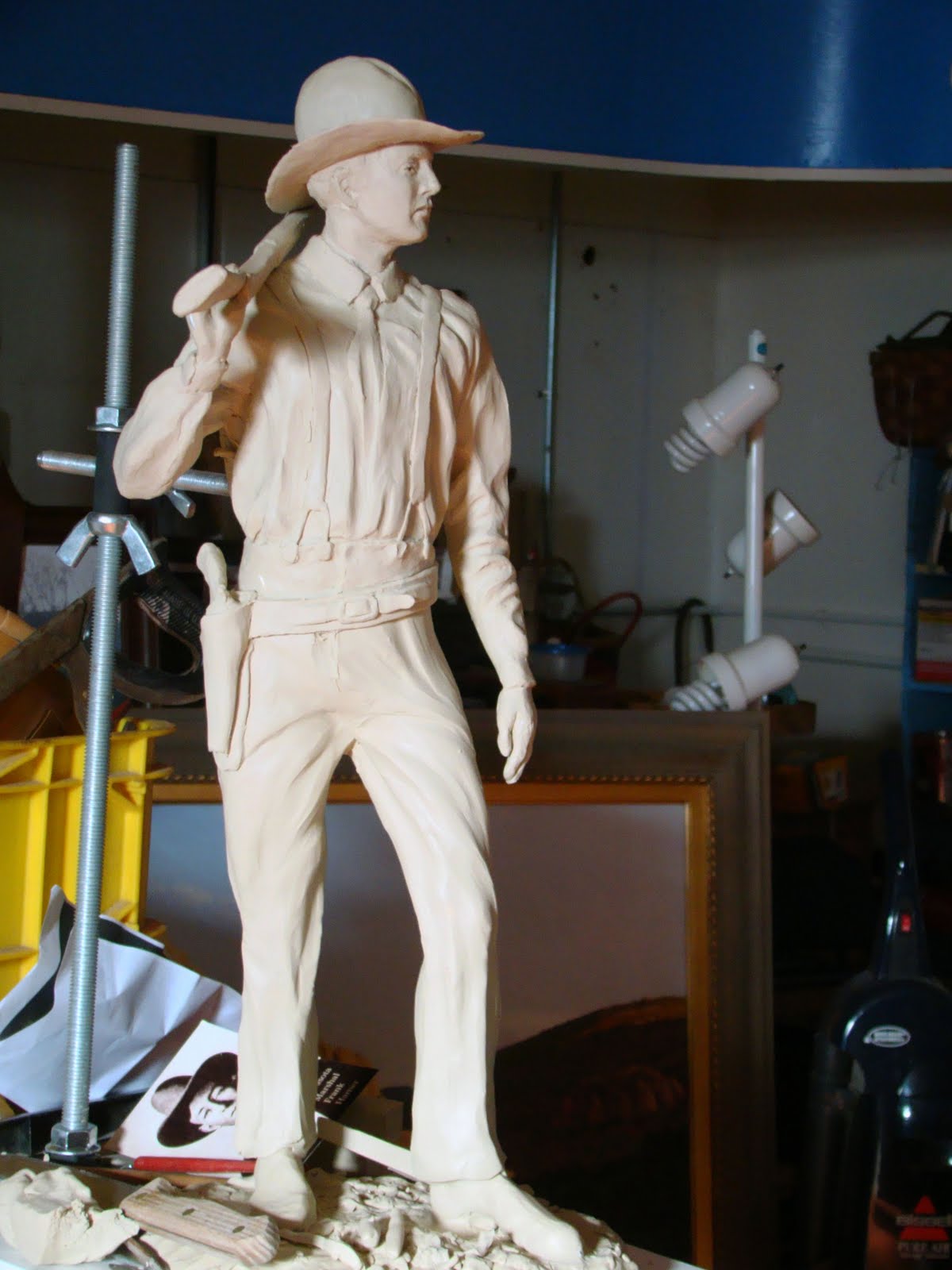
The moment of truth... final maquette of young Marshal Frank Hamer

These are photographs showing the progress from the model and the drawing concept to the final proposal of my Marshal Frank Hamer monument. If all goes well the City of Navasota will approve of the design and I will get started on the life-sized sculpture to be placed in front of the new City Hall. I'm getting pretty excited. This sculpture will also be cast in bronze, for anybody interested in a two footer, of one of the greatest Texas Rangers of all!

Perhaps the hardest thing in the beginning was to find a model... somebody to BE the famous Texas Ranger and Navasota City Marshal Frank Hamer for me, so I could get the concept rolling. Hamer was every bit of six foot three inches... This former Navy SEAL graciously posed for me, and I knew the rest would be easy. Thank you J_. M_.! In a big way, this sculpture is a tribute to all the brave men and women who make the world a safer place for us as Americans.

I started the proposal with one of artist Payne Lara's new armatures, now on the market, and WOW what a great product it is. Payne is a highly recognized and sought after Western and wildlife sculptor here in Navasota, and has used his vast experience in creating bronze sculptures to design these commercial armatures for the sculpture profession. He has thought of every possible requirement for a sculptor to get a sound start on sculpting a human form, in several different sizes. This armature saves the professional artist days of prep work. Yet if he cannot sculpt, it gives him no unfair advantage.

As you can see, when the actual clay form is created, there is no longer any trace of the armature. Here young Frank comes to life... without all the accessories of a Western lawman...

Now armed and ready, topped with his big hat, Marshal Frank Hamer steps out of history into the art world, ready for the City monument committee to see him.

When a maquette design is approved, I will go to one of my favorite places, the Texas Ranger Hall of Fame in Waco to see if they have any artifacts there to help make this sculpture as authnetic as possible. That ought to make a great blog!

Sunday, October 9, 2011

Diamond Six


You guys have probably figured out by now that I am a voracious reader. I hated to read when I was young, and now I can’t read enough. When growing up, my scholastic abilities were so non-evident that I was sure to be headed to a life of hard work and hard time. Then when I realized that I could learn… even understand, reading has been like a great seductive trail leading to wisdom and something far more useful… COPING WITH THE CRAZY WORLD AROUND ME.

That was, until I read enough to see that gaining and assimilating knowledge was hopeless, and just an addiction and delusion. The more I know, the more I realize the less I know... So as I share my latest read with you, it is not with an overview of comfort and resolve, but a growing suspicion of the whole process. But I have another reason to tell you about this book, as it helps illustrate the other subject I promised you... how traditionally Democrats have enjoyed overwhelming support from the Afro-American vote, even though they were originally their worst oppressors. The story of Wesley Smith is a fitting springboard for much I have to share on that subject, a great deal of which is covered in my book (unpublished) called The Light of Day.

Diamond Six is about Sheriff Wesley Smith, a former neighbor to Grimes County, the region where I have spent most of my adult life. When he came to Montgomery, Grimes and Montgomery Counties were just about to be split up, and young Wesley had been recruited, so the story goes, to serve in the Texas Rangers and fight Comanches over in... Navasota, my town. When I first read the book about him I was shocked at the history his biographer, his grandson, told of this area which was not recorded anywhere else. I dismissed the book, some twenty years ago as an unreliable family legend gone amuck in the imagination of a starry-eyed grandchild.

I have probably read the book four or five times since. I could not leave it alone. It was first recommended to me by Elliott Goodwin, one of the town’s acknowledged historians, as our history, albeit sealed in secrets of dark ways long since buried...

In a nutshell, Diamond Six is about a young Kentuckian who migrates with his brother to Texas to avoid prosecution for the killing of their father’s murderer. On their way they meet an "honest" gambler who GIVES them six diamonds as a token of his esteem. This is just the first extraordinary windfall of Smith's serendipitous life. But by the time they enter “The youngest nation on earth,” in 1844, They have a price on their heads and have used their guns to resist arrest and have even fired upon a border patrol of the United States Army.

And it gets much worse. They are soon caught up in shooting scrapes, Wesley is even commissioned as a Ranger, and he soon parts with his strife-weary older brother. Then the young fugitive successfully inspires a conspiracy among his fellow Texas Rangers to murder two bounty hunters from back home who are seeking to capture him and his brother, and the ten thousand dollar reward for their hides.

Serving as a part-time Ranger, and full-time farmer and later as a Lieutenant in the Confederacy, Smith kills untold Indians and Yankees, and because of his amazing luck, stumbles upon a Federal gold shipment during “the War of Northern Aggression” which, as fate would allow, he and his cronies successfully retrieve after the war, making all of them millionaires by today’s standards. With gold taken from the Federal Government. Of course, this was seen as justice and rationalized by the writer, who no doubt grew up in the largess of this wealth.

Often taking the law into his own hands, Wesley Smith, according to his own grandson, kills over sixty men, (not including Mexicans, Indians and Yankees) yet very few while working as a peace officer. It seems he was later elected Sheriff of Montgomery County in the 1880’s because he was so greatly feared and it was assumed it was expedient to just give him the badge, and let him and God sort it out. This was far more productive than arguing with such a prolific killer about legalities which he was bound to confront, doing his thing, which his grandson insisted was always justified. And this kind of logic was pervasive in the West. The Daltons and Earps and many other famous gunmen were all basically criminals-cum-lawmen.

The first time I read Wesley’s exploits, I shook my head and hoped it was not true. But there was the problem of his grandson, writing the book and claiming it was a true story. Why would a man make such claims, which could only establish his progenitor as lifetime criminal, if not a killer and a thief, unless it was truth. Yet even more paradoxically, the grandson failed to ever mention those facts of history that could be proven today. William Fielding Smith got a nationally famous novelist to edit his book, yet neither ever seemed to feel the need to mention that Wesley Smith had introduced and developed an important agriculture crop to Montgomery County, one that became an important local industry, that being tobacco.

True, by the end of the book you cannot imagine Smith without sporting one of his cigars, but we are never told that he had a cigar factory in Willis, or that Willis grown tobacco became a highly coveted product, winning international tobacco awards. There were eventually eight cigar factories in Willis, and Smith grown and made cigars were famous in Texas, much more famous than the dangerous man that produced them. The operation was finally reduced to oblivion when Congress passed laws that lifted import tariffs on Cuba, who immediately blew away all the competition.

By the end of Sheriff Smith’s life, his tobacco dynasty had been trounced, much like his ante-bellum cotton kingdom, and all that was left was his sizable cattle operation, which had been overseen by a couple of dozen unreconstructed confederates who served as his personal posse and jury and executioners for scores of rustlers. And when the old sheriff died, so did the alliance, the secrets, and the dangerous ground they protected. Strangely, when William Fielding Smith sat down to resurrect his family’s legacy, he ignored the obvious and strained at the radical, almost unbelievable legend of his grandfather. One that might well have been better forgotten.

Like me, I suppose the grandson could not resist the attraction of a great story.

And now after many readings, I am finally looking at the story through a different lens. It cannot all be a lie. Perhaps a lot of it is second hand, and distorted and unreliable. But in all of it there is the ring of truth. So I want to share some of the amazing parts of this “true story” that have haunted me for two decades, and introduce you, if not to the world of Sheriff Wesley Smith, to the muddy memories of his devoted grandson. And the sinister politics behind it all. Next time.

Friday, November 19, 2010

Navasota's greatest Texas hero: Frank Hamer

The City of Navasota has erected a new bronze monument of Ranger Frank Hamer, and I had the privilege of making it.


[Above: Standing 6' 2", Texas Ranger Frank Hamer was the reality that Western actor John Wayne could only pretend to be.]

Everyone has heard of John Wayne... a man who acted brave and dangerous. We have heard of Pancho Villa, a man who brought terror and destruction. We have heard of Wyatt Earp, who broke the law repeatedly to kill his enemies, and was prosecuted for it. But strangely, we Americans have rarely edified men who truly deserved our praise and admiration. We have made famous the beautiful, the controversial and the scandalous, gave fame to those who desired it, and usually overlooked the real heroes of our generation.

History is full of great men and women who never became famous. Texas history is especially blessed with many notable characters who never captured the eye of the myth makers of Hollywood, who have picked our heroes. Frank Hamer is one of the best examples of larger than life Texas heroes who are known well in small informed circles, in his case enthusiasts of Texas Ranger history, but virtually unknown to the average citizen. After you have read this, perhaps that miscarriage of fame may begin to change.

Everyone has their own idea about who should be famous and why; Soldiers for winning battles, politicians for winning elections, athletes for winning competitions. We like winners in our history. We like pathfinders, innovators and those who left a mark on their own generation, and perhaps still challenge our own. We like those who were the best in their fields, record-setters and the firsts of human accomplishments. We like our history to offer up attractive, successful, standard setters who still amaze us. Frank Hamer was all of these.

Frank Hamer was named by historian and western author Walter Prescott Webb as "…one of the three most fearless men in Western history." If you have not heard of him, you probably have never studied the history of law-enforcement in Texas, or the most respected of Texas Rangers, the man who stopped the murderous crime spree of the infamous “Bonnie and Clyde.” Frank Hamer was all of these too. In one of life’s ironies and absurdities, several movies were made about them, always minimizing their hunter and slayer, and making romantic heroes of them. One movie even made Frank Hamer out to be a blundering fool. So let’s get the story around Frank Hamer straight, and right a little bit of history if we can. And I will do it as briefly as I can, as I know most people do not like history and have little patience for it… Unless it is a warped and sexy version with Faye Dunaway and Warren Beatty in it.

Born in 1884, Frank Hamer grew up in the western half of Texas, in the 1890’s, where the Indian Wars were still remembered and cowboy culture was the predominant lifestyle and Mexican banditos were still a daily threat. The West had been “won,” but had not been tamed. Many men in Texas still wore a sidearm, and used it whenever it seemed necessary. All of the stereotypes of the “Old” West were still very much in activity, and men who were the sons of the pioneers, the cattle drivers and the outlaws were still trying to walk in their father’s footsteps. Frank Hamer was engaged in his first kill-or-be-killed shootout with a corrupt and angry boss when just sixteen years old. He suffered multiple gunshots and was almost killed. When he recovered from his wounds, he returned to his former employer and finished the exchange, killing his first badman. This was the unwritten “code of the West,” where men settled deadly differences with their six-shooters and often faced little if any, legal consequences.

If Frank Hamer had been anything less than an authentic Western alpha-male, he would never have seen his seventeenth birthday. And he was not through with danger. When twenty years old, he tracked down and arrested some horse rustlers and took them to jail. Later he tracked and captured another horse thief for the local Sheriff, who began to see potential in him, and contacted the Texas Rangers. The Rangers saw in him the mettle necessary for taming the West. He was hired as a Ranger when just twenty-two years old. Enlisted as a Private in Company C and based in Del Rio, he was soon chasing Mexican bandits and impressing his superiors with his mental and physical ability. During this first assignment he showed extreme bravery and shooting skill during a shoot-out with a desperate killer, who had commandeered a home and would not be taken alive. In a hail of gunfire, Private Hamer fearlessly positioned himself near the window where the outlaw’s shots were originating. One of his lever action Winchester bullets had entered the crazed gunman’s left jaw and ended up in his heart. The legend had begun.

Frank left the Texas Rangers to be Navasota City Marshal in 1908

In 1908 when the Navasota City Council approached the Governor of Texas for assistance in quelling the violent and lawless forces in their town, the Rangers looked no farther than Frank Hamer. Although the incorrigible town of Navasota had been unable to keep lawmen very long, because they would always be intimidated or bought off, Hamer came and conquered. Blues legend-to-be Mance Lipscomb, just 12 years old, was hired to be his buggy driver. He drove the young lawman around Navasota proudly, and remembered the new Marshal to be fair and brave and a terror to outlaws with his feet, which he used to kick them all the way to jail. His “feet were always loaded,” and Marshal Hamer was known to put down his guns and whip any defiant punks who challenged him, and would often use vicious kick boxing techniques to subdue his foolish challengers. He avoided the use of firearms, and for the first time, absolutely forbade sidearms on the streets. Marshal Hamer thwarted train robbers, shot robbers and even contentious dogs, and shut down the gun play that had ruled the streets. He was feared and respected and in the end, loved by many who saw the town transformed into a decent place to live. By 1911, Navasota had been tamed, and like the Old West, became a kinder and gentler version of its former self. But Texas was big and there was still great work to do.

He went to work in Houston for the Mayor as a special agent, where he tracked down and captured a cop-killer called “Mississippi Red.” He captured an escaped convict and outran a drunken sideshow entertainer billed as the “Wild Man of Borneo” and disarmed and arrested him. He busted up a burglary ring. He even arrested a fellow policeman who beat a man unnecessarily. And then, caught up in reckless accusations by a Houston Press reporter, Special Agent Hamer lost his cool and smacked the culprit. Soon he became a political liability to the Mayor, who quietly appreciated his resignation.

Frank went back where he belonged… to west Texas. By 1915 he was back in Company C, this time defending the Texas border country against a poorly organized invasion of sophisticated banditos executing an insurgency known as the “The Plan of San Diego.” On the verge of WWI, the Germans were aiding and abetting these Mexicans in their attempt to reclaim the American Southwest. Towns and ranches were raided and innocent travelers murdered. Many manhunts and shootouts and even some wartime style martial law was used to protect Americans and their property. One battle led by Sargent Frank Hamer at Candelia, Mexico ended the dispute, when dozens of the banditos were killed in a bloody firefight.

This is where those sensitive to Hispanics might question Hamer’s methods. But history is never so neatly understood, or our heroes so predictable. Soon The Carranza regime of Mexico had proven it would not be allied with Germany, and even welcomed help in fighting its revolution led by Pancho Villa’s “Villistas.” The Mexican Government plead with American authorities to stop the flow of arms across the border, which only equipped the revolutionaries. American law forbid this anyway, but many gun runners continued to sell arms to the Mexicans. The Texas Rangers were told by “higher ups” to act as if they were policing this smuggling nuisance, but in reality to ignore it. Many Rangers obeyed their orders, but Frank Hamer continued to enforce the law. Since Captain Hamer could not be overtly stopped, those interested in helping the revolution arranged to have all the Rangers relocated except one. Frank Hamer alone was left to enforce the laws he was sworn to uphold. And that he did.

Left to his own devices to patrol hundreds of miles of border, and therefore quite vulnerable, Hamer turned the tables on International relations and law enforcement. He crossed the border and joined forces with the Mexican police, who were more than happy to be allied with the legendary Ranger. Soon he led a small army of Mexican lawmen, who made his goals safer and more attainable. Hamer led a successful war against American gun runners from the other side of the Rio Grande, and enjoyed reciprocal assistance from Mexican authorities from then on. Frank Hamer was not ever against anything but lawbreakers, of any race or nationality.

Their corrupt schemes frustrated at every turn, authorities in Austin had Ranger Hamer yanked from his cooperative with the Mexican officials and assigned to the Hill Country to harass cattle rustlers for Texas cattlemen. That was just fine with him, as the border was an immense, wild bad land, where law enforcement was like stomping around an acre of ants. Rustling rustlers would be like eating ice cream.

Ranger Hamer, pictured above in black hat and tie, was famous along the Rio Grande as a lawman that got the job done, with or without help. Sometimes the Mexicans were more helpful than the Americans.

By 1918, World War I was winding down, and a new enemy had risen on the horizon; Prohibition of alcoholic beverages... and its enforcement. Many law enforcement officers walked away rather than be forced to arrest their friends, family and neighbors. But Frank Hamer figured that anybody that knew how to bootleg whiskey, and was willing to play the game of crime was probably bad company anyway. The formidable Ranger was recruited to help with State prohibition efforts. He was reassigned to border duty, where he excelled at catching Mexican smugglers who were bringing caravans of tequila and Mexican moonshine into west Texas.

Frank Hamer was photographed for a magazine article in 1920 during a joint exercise on the Texas- Mexican border between Texas Rangers and Mexican police to halt whiskey smugglers during the days of Prohibition.

In 1921, Captain Hamer organized a fateful rendezvous with a notorious robber and killer named Rafael Lopez. Lopez had killed five men in Utah before hiding out in Mexico with the Villistas. Then Lopez and his men had robbed a train and killed 19 people in the process. When a man had offered to betray the bandito, Hamer and his men stepped into a devilish assassination scheme. But just in time the legendary Ranger smelled the double cross and moved his men to a safer position. When a hail of gunfire poured into the spot where he had just been standing, he returned the lead and took out one of the worst killers in Western history.

Frank became the star witness in a murder trial in Abilene. The defiant defendant hired a gang of professional killers to kill him and keep him from testifying. As a local Grand Jury watched most of the bloody scene play itself out below their window, he and his family were jumped and he was shot in a couple of places, but managed to forever silence his enemies in the shootout. Wounded seriously, he still had the presence of mind to stop his enraged brother from shooting one of the fleeing assailants in the back. The stunned and thankful Grand Jury no-billed him, and even thanked him for his admirable ethics.

But then something happened to the Ranger service Frank Hamer could not stomach. In 1925 the “Governors Ferguson” returned to power after James Ferguson had been convicted and banned from office. His wife was elected Governor and aggressively renewed their painful dynasty of corruption and nepotism and cronyism and a pervasive lack of professionalism. Ma and Pa Ferguson had a policy of giving anybody they liked a Ranger badge. The Texas Rangers organization became an embarrassment to all law- abiding people. “Ferguson Rangers” were typically local yokels, slovenly and unprofessional, who used their office for personal aggrandizement. Hamer threatened to resign, but cooler heads enticed him to stay for the good of Law and Order. Hamer bounced around trying to find other employment he could feel right about, and finally officially left the Rangers in 1932 out of protest and personal pride, even as his brother Harrison was being sworn in to take his place. Even the Ferguson's believed that you had to have a Hamer on the Force to have any credibility.

In 1928, Hamer was hired as a bounty hunter in Houston and exposed an insidious murder for hire ring, inadvertently sponsored by Houston banks, where outrageous rewards were being offered to kill bank robbers. No rewards were offered for live ones. Money greedy bounty hunters had found the perfect crime. Vagabonds and loiterers were set up as stooges and then killed, so crooked bounty hunters and even some lawmen could collect large rewards. The Texas Bankers Association had become a law unto itself, and many lawmen just shrugged at these methods. But Frank Hamer took the story to the newspapers, and defied them to take action against him.

But perhaps the most telling account concerning Frank Hamer’s career in law enforcement was during the so-called “Sherman Riots.” In 1930 A black man named George Hughes had been accused of sexually assaulting a white woman. A lynch mob, said to have been numbering in the thousands, had gathered outside of the Grayson County Courthouse and had come to administer their own brand of Western justice. It had been rumored that the Governor had forbid anyone being shot at during the protection of this defendant. In other words, if the mob comes, let them have him. It is easy to imagine that Hamer’s enemies in Austin had sent him to Sherman knowing they were throwing him into the lion’s den. So Captain Frank Hamer, now the Texas Ranger always called upon in the worst situations, had been assigned to protect Hughes, a foolish and deadly and probably impossible task. And not surprisingly, Hamer had not gotten the memo. He was the lion in the den. He would do his job, and stop any person who threatened those in his custody, even a man suspected of sexually assaulting a white woman.

Unfortunately, most of the east Texas vigilantes had never heard of Hamer, and did not know what kind of lawman they were dealing with. Frank Hamer and his Rangers stood at the Courthouse steps and backed down the angry mob, who had developed considerable courage because of the supposed statements from the Governor. Hamer warned them to stay back, and argued that these supposed orders were not true, and assured that anyone who advanced towards them would be shot.

Frank Hamer did not care whether the Governor’s alleged statements were true or not, he was there to enforce the law. When finally the mob decided to take their chances, and charged the Rangers, the Rangers leveled their guns on them.

This may have been one of the few times in the early Twentieth Century when white Southern lawmen shot white lynch mob members in order to protect a black prisoner. In most other cases, the law would usually step aside and let the mob have its way, out of fear for their lives. But Frank Hamer had not been assigned to those details. Unable to have their way, the mob waited until later and then burned the Courthouse down, in order to kill the prisoner who had the luck of being escorted by Ranger Frank Hamer. But they dared not face the Ranger and his men again.

Ranger Frank Hamer may be the only lawman to have so blatantly challenged equally the worst criminals of the day and the powers that be in Austin, and anyone who broke the law, to his own demise. More than once he turned on his fellow lawmen, or his employers, and he repeatedly ignored the state powers in Austin, as he did his job, often against impossible odds, and consistently challenged lawbreakers of every race or social class, and shed light into the darkness, no matter who was implicated, and no matter the cost to himself.

The cost? After some fifty plus gunfights, Frank Hamer was a bundle of scar tissue. In the process of exchanging gunfire with around 20 men and one woman, in life or death battles, and countless garden variety scrapes, he was injured in the line of duty 23 times. His body was a half-Century collection of bullet and knife wounds and shotgun pellets under the skin. Hamer was forced to resign or was reassigned to keep his job numerous times. This was a big sacrifice for him and his family as they moved around a great deal. There were many inconsequential attempts on his life, which had to take a psychological toll on his family. How do you put a value on such sacrifice? Most people would not have lasted, but surely few would ever have done what he did for such pay. And yet, there are those who say he was cold-blooded, arrogant, even a law unto himself, not very likable, and much worse. So-called historians and latter day pundits judge Hamer by modern, perfect-world, if not down right impractical standards, and dare question his goodness or integrity.

That too is the cost of public service; A naive, thankless and critical citizenry, who could never walk in his boots, would ignore or denigrate his amazing service because it required so much... violence. Yet it was a barbaric and violent society that demanded such a Ranger, such a hero as this... Frank Hamer.

Frank Hamer was the only man who could have walked that walk, and many Texans thanked God that he was out there, chasing, and yes killing those bad guys. Those that challenge him one hundred years later, would be the first to run to him for protection if they were to chance upon the kind of overwhelming evil that ruled this place then.

I have only mentioned a few outstanding cases, but Hamer’s life reads like a super hero. But it is obvious to me that tracking down and exterminating Bonnie and Clyde was just a small part of his life. After spending some time with him, Hollywood cowboy actor Tom Mix encouraged him to become a Western hero on film, as he was already the real thing. Ranger Commander Hughes said he may have been one of the bravest men he had ever seen. Other writers have proclaimed him one of the greatest Texas Rangers of all time.

So it is fitting that there was a movie being created about him. It may never see the theatres, but there is no reason why the people of Texas should not venerate this great man. A bronze statue of him is long overdue. One erected in Navasota, the town where he cut his teeth and began his lifetime of public service would be real Justice in my mind, if not poetic justice for me.

You see, this great lawman was an acquaintance of my father's. He first met him late one night when Captain Frank Hamer carried a bleeding, unconscious relative into my grandmother’s home after he received serious injuries during a Strike riot on the docks in Houston. Hamer had been there to bust up the Strike, and caringly brought one of his helpers home to be doctored. Many historic characters graced my grandparents home, but he was always considered one of the greatest. Later my father interviewed him when working as a writer for the Texas Highway Department. Their magazine wanted an interview, but Hamer would not give one. My father, ever outgoing, used his family connection to get the interview. As usual it was pretty gruff and uninteresting, as one writer later recalled, Hamer was “as talkative as an oyster.” But for my father, who became a published author, it was a personal triumph, and a highlight of his writing career.

I grew up hearing about the big Texas Ranger, who knocked down rows of men with his huge paws like a bear, who hardly ever used a firearm in the line of duty, but could shoot the eye out of a flying bat at night, if he wanted to. A lawman who never backed down and never lost a fight, and who never showed favoritism. A man who kept to himself, raised a pet javelina, and shot tin cans down the road with deadly precision with his six shooter while driving, for sport. As you can tell, I have only gotten warmed up about Frank Hamer. Even though it would be fitting to sculpt a monument honoring this Texas hero, the fact is, no artist, and perhaps no movie could ever do him justice. But of course, I would still like to try.

To read more about this amazing Texas Ranger, click below;

http://russellcushman.blogspot.com/2012/03/frank-hamer-amazing-record-of-race.html

There is also a page of articles on Frank hamer:
http://www.russellcushman.blogspot.com/p/frank-hamer.html

Note: I want to thank the City of Navasota for the commission. This blog is now full of entries of the sculpture  process, which is now another chapter in Frank Hamer's history. To read about that, click below:
http://russellcushman.blogspot.com/2013/03/what-day.html