Looking for Russell Cushman art ?: http://russellcushmanart.blogspot.com/

Looking for BLUES HISTORY?
http://brazosvalleyblues.blogspot.com/

Looking for ARTS & ENTERTAINMENT?
http://brazosvalleyarts.blogspot.com/

Showing posts with label thanksgiving. Show all posts

Tuesday, November 22, 2016

"HERE is a way" - The Logic of One Pilgrim

 A couple of Cushman-Plymouth souvenirs.

My people have been in this land for almost four hundred years. Yes, my ancestors came over on the Mayflower. And after starvation and suffering from exposure and all kinds of suffering, the “Pilgrims” at Plymouth found gratitude beneath their blanket of hardship. What WERE they thinking?!

We should care what they were thinking, because no other migration ever set into motion the wealth of Providential events we have seen on our continent over the centuries. Largely under-utilized before its “discovery” by Columbus, the New World soon provided much of the food, inventions and progress which blessed mankind ever since. We as Americans have lived and celebrated the greatest, most advanced and prosperous nation in human history. So it is easy to forget that it all had a very ugly start.

A full half of the pilgrims died the first year. Those who survived shared homesickness, starvation, exposure to the elements and unbearable grief.

There were no doctors, or stores or letters from home. The Natives watched from the treeline and pitied them. Soon they were bringing them essential help. The first miracle God provided was a Native American in this remote wilderness who spoke English, and who could and would help them get through those first months.

At the first harvest on their primitive plantation, they instinctively threw a festival of sorts, and invited their aboriginal neighbors over for a thanksgiving feast! WHAT were they thinking! They could have been easily massacred right then. But their faith was strong that the worst was behind them, and God was in charge. Strangely, hardship and mortality bring us closer to our Maker. Instead of cursing God for their painful saga, they were singing God's praises. This suggests that a happy, prosperous people (like us) will never grow towards God, but away from Him.

A short while later the pilgrims held their first worship service led by one of their elected shepherds, (and my ancestor) deacon Robert Cushman. Cushman had helped expedite their adventure and originally embarked with them on a separate ship, the “Speedwell” which almost sank, and was forced to turn back. He had just arrived from England with supplies and welcome news from their homes. And he gave them a prepared sermon, recognized as the first (recorded) sermon delivered on American soil, in December of 1621.

It was a warning to avoid self-pity and narcissism, or “self-love” as he called it, and he challenged them to think not of themselves but the ultimate success of the colony. Deacon Cushman commanded them to be heroes, and nothing less. And this is why: Cushman had looked down the road at their home in Europe. A great deal was at stake. He wrote in the dedication of his historic sermon this rationale...

And if it should please God to punish his people, in the Christian countries of Europe (for their coldness, carnality, wanton abuse of the gospel, contention, etc.,) either by Turkish slavery, or by popish tyranny, which God forbid, yet if the time be come, or shall come (as who knoweth?) when Satan shall be let loose to cast out his floods against them, here is a way opened for such as have wings to fly into this wilderness...” He saw a grand strategy at work, and these pilgrims would serve an essential role... so a light may rise up in the dark.

To Robert Cushman, the world was going to hell in a corrupted European handbasket, and the fate of Christian civilization (and thus mankind) could very well have rested in those hands which cupped this “candle in the wind” in the New World.

Robert Cushman was right about Europe... long before Napoleon and the so-called “Enlightenment” and apostasy became the backbone of European intellect. America did carry the ball for Christ for the next few hundred years... and it all started with great sacrifice and discipline like that in Plymouth.

In hindsight, most of us would agree that it was worth it. We are the most fortunate of peoples to live in a land established by God's hand-picked heroes of Faith. And there is no secret as to how they accomplished this amazing legacy. The slogan “In God We Trust” had deep origins rooted in blood and tears.

The pilgrims were not just a random assortment of boat passengers. Even from the beginning, they were representatives of two very different lots. The leaders and believers in Christ were called “Saints” and the rest of the people, workers and sailors, were “Strangers.” The pilgrims understood that they must partner with and work alongside strangers who did not share their beliefs or value system. They kept their faith and obeyed God and let Him sort things out. That partnership gave birth to the greatest nation on earth.

Today we must remember how and what and WHO got us where we are. Humbly. Gratefully. On this Thanksgiving, as our country slips into cynicism and self-sufficiency, Americans must ask themselves, if they want to enter the next chapter in our history without the guidance and support of a God who has blessed us so greatly... Because without Him we will be no better off than most other countries in the world. And they had a huge head-start on us, but can never match American exceptionalism

And unlike in Robert Cushman's paradigm, there is no next place to fly.

Wednesday, November 27, 2013

Being Thankful For One Day


I live in a region where you could still run over a turkey while driving down a public road... or a goat or sometimes even a cow. And I am thankful for that. I live where people and livestock still relate to one another, eye to eye... Where the same guy you know that traps wild hogs keeps one for a pet...


Where you can occasionally see the graceful serenity of animals living on the land. Or you might see city folks out enjoying the world I live in every day...


I live in a neighborhood that is just as likely to produce a possum on the porch as a salesman. And I am thankful for that as well.


Where the antiquity and beauty of my surroundings speak of the good life and the way God intended for us all to live. When I take a walk, it is hard not to run back to the house and get my camera and start taking photographs. You gotta know I am thankful for that.


The truth is that the Lord gave me everything I ever truly wanted... Love, belonging... significance. A hometown that felt like home. A family that has always been there for me. And a beautiful world to give me inspiration, every day.


I'm not one of those "perfect worlders," in fact I know that the world IS perfect... it's people who mess it up, trying to improve on what looks pretty wonderful to a lot of us.


Wild tree ducks made young on my block, right here in town...

Maybe it would be more appropriate if we set aside just one day every year to forget to be thankful, instead of the other way around...


Anyway, if you ever visit my world... watch for the turkeys... and coon dogs and stray goats... and be thankful for them, they are our daily reminders to be grateful, and they are a perfect welcoming committee!
 

Wednesday, November 23, 2011

“Thanksgiving”: A Civil War Tradition!

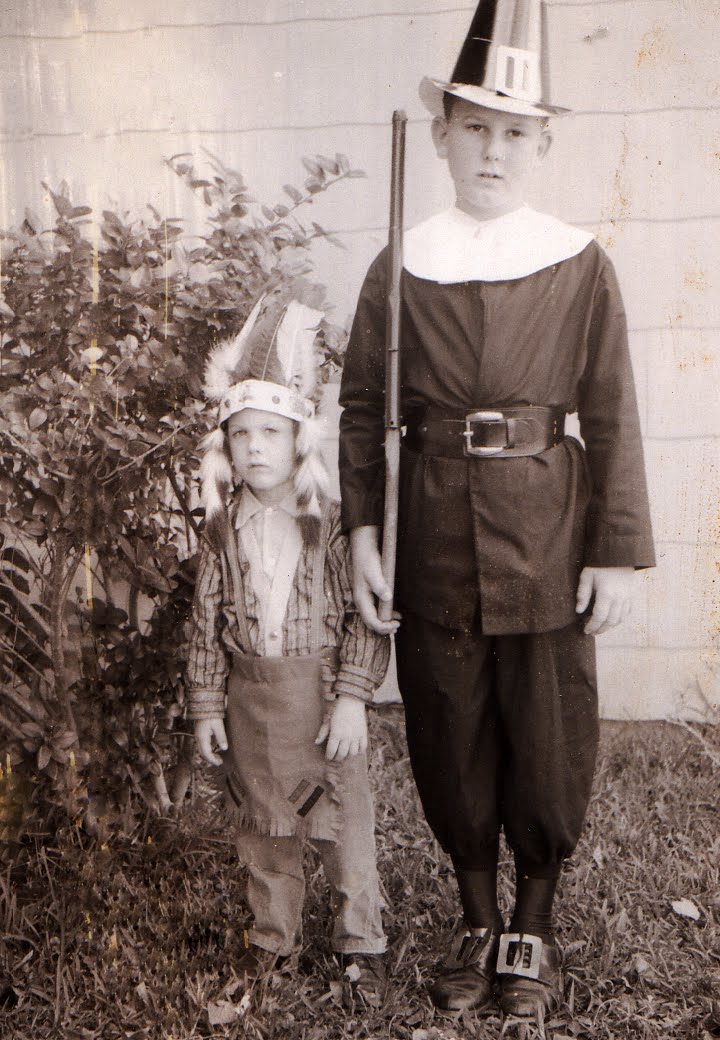
We Cushmans were raised on Pilgrim lore... That's my brother Ralph in that authentic Seventeenth Century posterboard hat... and me as Squashtoe...

The Legacy of the Mayflower pilgrims is stepping out in Faith, even in the worst of situations, in a spirit of gratitude.

Most Americans think they know what Thanksgiving is all about… and that includes it beginnings. I can assure them right now they don’t. And you’ll be surprised, hearing this from a Pilgrim descendant, what this National holiday is or was really about. You may know of my Pilgrim lineage, out of Robert Cushman, one of the men who chartered the Mayflower... but our celebration of Thanksgiving is only indirectly related to him or his fellow Pilgrims

The year is 1863. President Abraham Lincoln has watched as his happy marriage, his Army, even his beloved Country has gradually fallen apart. In the throes of the American Civil War, which is not going well for his side, he received news in late September of the bloodiest and deadliest two days in American History. A total of thirty-five thousand men from both sides of the conflict were either wounded or killed at the Battle of Chickamauga. Lincoln’s brother-in-law, Confederate General Ben Hardin Helms is found among the dead.

A couple of days later, Union General Sibley led a victorious attack against the Sioux Nation, ending the “Great Sioux Uprising.”
The blood of red and white, blue and gray, dried comingled on the war-torn soil, from North to South.

President Lincoln had gotten a plea from a woman with a passion for national unity, one Sarah Josepha Hale, editor of Godey’s Ladies Book, and an all around National do-gooder, who wanted to unify all the various annual observations of thanksgiving throughout the Country. Finally after a fifteen year campaign, she convinced President Lincoln to make a Presidential Proclamation, establishing an official National Day of Thanksgiving and Praise. On October 3, 1863, he did just that. Here is the proclamation that William Seward, his Secretary of State, wrote for him:

The year that is drawing towards its close, has been filled with the blessings of fruitful fields and healthful skies. To these bounties, which are so constantly enjoyed that we are prone to forget the source from which they come, others have been added, which are of so extraordinary a nature, that they cannot fail to penetrate and soften even the heart which is habitually insensible to the ever watchful providence of Almighty God. In the midst of a civil war of unequaled magnitude and severity, which has sometimes seemed to foreign States to invite and to provoke their aggression, peace has been preserved with all nations, order has been maintained, the laws have been respected and obeyed, and harmony has prevailed everywhere except in the theatre of military conflict; while that theatre has been greatly contracted by the advancing armies and navies of the Union. Needful diversions of wealth and of strength from the fields of peaceful industry to the national defense, have not arrested the plough, the shuttle or the ship; the axe has enlarged the borders of our settlements, and the mines, as well of iron and coal as of the precious metals, have yielded even more abundantly than heretofore. Population has steadily increased, notwithstanding the waste that has been made in the camp, the siege and the battle-field; and the country, rejoicing in the consciousness of augmented strength and vigor, is permitted to expect continuance of years with large increase of freedom. No human counsel hath devised nor hath any mortal hand worked out these great things. They are the gracious gifts of the Most High God, who, while dealing with us in anger for our sins, hath nevertheless remembered mercy. It has seemed to me fit and proper that they should be solemnly, reverently and gratefully acknowledged as with one heart and one voice by the whole American People. I do therefore invite my fellow citizens in every part of the United States, and also those who are at sea and those who are sojourning in foreign lands, to set apart and observe the last Thursday of November next, as a day of Thanksgiving and Praise to our beneficent Father who dwelleth in the Heavens. And I recommend to them that while offering up the ascriptions justly due to Him for such singular deliverances and blessings, they do also, with humble penitence for our national perverseness and disobedience, commend to His tender care all those who have become widows, orphans, mourners or sufferers in the lamentable civil strife in which we are unavoidably engaged, and fervently implore the interposition of the Almighty Hand to heal the wounds of the nation and to restore it as soon as may be consistent with the Divine purposes to the full enjoyment of peace, harmony, tranquility and Union.

But what about the Pilgrims? You ask. The Pilgrims had a “harvest feast” every October at the end of the harvest season and celebrated it with a big banquet. They invited some of their Indian friends and everybody brought something to share. The first Harvest Feast was a bit sparse, as their crops had not done well and their efforts to raise wheat and barley and peas went unrewarded. But there was lots of corn! The adopted Indian Squanto, their farming mentor had helped them with the native plant, so there could be fresh corn, hominy, cornbread and yes, grits.

But other Indians brought in some deer, and the pilgrims shot some ducks and geese, and the pilgrim women found some clams, wild plums and leeks and watercress to round out the meal. Somebody had made some good old homemade wine from the plentiful wild grapes in the area, which was a big hit.

As far as we know, no turkey. No pumpkin pie. They had cranberries but historians are pretty sure they had not figured out yet what to do with them. So our Thanksgiving traditions do not come from… the first thanksgiving… Those are things more likely representative of the Victorian (Civil War period) palate.

Whatever it was, the Pilgrims of old, the first thanks-givers, had a great time and did it for generations, every year, to remember what they had all been through… and what God had delivered them out of.

Perhaps that was Lincoln’s Thanksgiving intention as well; Probably inspired by the Pilgrims, he was determined to be grateful, and lead his nation in gratitude, even though his heart was broken and he could not see any light at the end of the tunnel. Just days after the beleaguered President made the proclamation for Thanksgiving and Praise, he was invited to make remarks at the dedication of a battlefield cemetery where thousands of Americans had died, and the battlefield had been tidied up so they could pray over it. At Gettysburg. Lincoln gave his short address, thinking that it had been a big failure. Just like the war… Just like that silly proclamation about Thanksgiving. And sadly he was assassinated before he ever saw the Country healed from his war, or blacks truly enfranchised, or the tradition of giving thanks practiced all over the United states of America. All 50 of them.

But according to Abraham Lincoln, Thanksgiving is something you do as a matter of Faith, even when you cannot find much to be thankful for. True Faith starts with gratitude. .. Unconditional gratitude.

You thank the Almighty, and put the ball in His court… you plant the seed, and you wait upon Him for it to grow. You never give up. You hold on, in fact you do greater things than you ever thought possible. Lincoln knew, it is when we are at the end of our ability, the end of our rope, and we admit it, when God steps in and does the rest.

That way we know who and what we are, and who and what God is. Lincoln knew God was waiting for somebody down there to acknowledge Him (not just ask Him for victory in battle!), and that had to start with being grateful for whatever God in His mercy had allowed, in His wisdom, for each and all of us. And as it turns out, that is something we need to do quite often, and as a Nation, every year.

Happy Thanksgiving.

Monday, November 22, 2010

390 years ago... LOST & FOUND


It was 390 years ago that a disheveled, starving group of adventurers came ashore and began a treacherous ordeal at "Plimouth Plantation" that killed half their number in just several months. You know them as the "Pilgrims." I know them as my ancestors. As you celebrate Thanksgiving, an observance that was not officially recognized until hundreds of years later, you might enjoy learning some stuff, from a real Mayflower descendant, what your history teacher never told you.

Robert Cushman, my ancestor, was a church leader at an assembly of Separatists, English "Brownists" in exile, who met and worshipped at a church called the Green Gate in Holland. They were not a happy bunch. Cushman explained the conditions in Europe at the time... "The rent-taker lives on sweet morsels; but the rent-payer eats a dry crust often with watery eyes… many there are who get their living with bearing burdens; but more are fain to burden the land with their whole bodies. Multitudes get their means of life by prating; and so do numbers more by begging. Neither come these straits upon men always through intemperancy, ill husbandry and indiscretion, as some think, but even the most wise, sober and discreet of men go often to the wall, when they have done their best… Each man is fain to pluck his means, as it were, out of his neighbor’s throat. There is such pressing and oppressing, in town and country, about farms, trades, traffic & co; so as a man can hardly anywhere set up a trade, but he pull down two of his neighbors. Let us not thus oppress, straighten, and afflict one another! But seeing there is a spacious land, the way to which is the sea, we will end this difference in a day!"

(Robert Cushman, Reasons And Considerations Touching The Lawfulness of Removing Out Of England Into the Parts Of America.)

He was selected with another man named John Carver to go to King James and arrange passage to the New World, so they might enjoy freedom of religion and avoid persecution in England by the Anglican Church.

It took three frustrating years and lots of compromises and concessions to arrange the passage, and in the end, most of the members of Cushman's church chose to stay home rather than suffer the indignities of the contract Cushman and Carver ended up with. The settlers would be under a bond to work off their passage for seven years, and in the end, the homes and gardens they built would not belong to them. It was the best deal the Pilgrim negotiators could get, but it was not popular with the folks at Green Gate. Non-believers, known to the "Saints" as "strangers," were taken aboard to fill the ships, and gather the workforce necessary, which finally took off in late August. There were seventy-six adventurers, (not to mention the 26 children of the passengers) including as Skipper Jones counted… “Thirty-four men, nineteen women, five hired hands and sailors, eleven men going under bond… one woman servant... six orphans. WHAT are these orphans?”

In a great act of charity, homeless waifs from the streets of London, between seven and twelve years of age, were now apportioned amongst the settler’s families. They could not have been left behind. In fact their services were needed. But few would survive the first year.


One of the two ships turned out to be faulty or sabotaged, and Cushman wrote: “I pray you… prepare for evill tidings of us, every day… I see not in reason how we shall escape even ye gasping of hunger starved persons: but God can do much, & His will be done… Poore William King & myself doe strive who shall be meate for ye fishes, but we looke for a glorious resurrection.”

Eventually the questionable, leaky ship was was left behind, and twenty or so would-be Pilgrims, including Robert Cushman never made the first voyage. I am a Mayflower descendant because Cushman's son married Mary Allerton, who was the youngest passenger on the Mayflower, when just 2 years old. Robert Cushman came the next year with his son Thomas, and after preaching a sermon, left his son in the care of Governor Bradford. They never saw each other again.

Robert Cushman left many precious quotes behind, as he wrote his church often as he labored for their cause, which in the end, was not what anyone had originally intended. He warned the voyagers of the continued delays, prophetically warning they had “already delayed overlong in regard to the season of the year…” and as he feared, “They would find to their cost.”

On Sept 6, after several attempts, the pilgrims left England, way too late to avoid a difficult voyage and with scant time to establish shelters in New England before winter set in. On board, the 102 pilgrims survived on hard tack, “salt horse,” dried fish, cheese and BEER. The first item of thanksgiving, besides the schnopske, was the Mayflower itself. The cargo ship proved to be the best acquisition that Deacon Cushman had made, large and sound, and more than seaworthy. Never-the-less, at least three people died before they arrived in their new home, which was only settled on because they were lost. After searching for the mouth of the St. Lawrence, they gave up and took what they could find...

Pastor John Robinson had said “All great & honorable actions are accompanied with great difficulties, and must be both enterprised and overcome with answerable courages.” Of course, he had never boarded any of the ships, and stayed back in Holland.

Unbelievably, at least two Indians showed up who could speak and understand English, and they made the first year possible for those who survived. It is doubtful that any English friendly natives would have been around where they had intended to land. One of them, named Squanto, was killed trying to protect them from other Indians. To me, that's what Thanksgiving is all about. When God calls us into action, to do hard things, He has already prepared our way, and provided miracles to make our mission possible. And those of us who do some of what he tells us, and cross bridges or great waters or difficult walls, give thanks for His Providential sufficiency.

Paul said "I can do all things through Christ..." but we rarely ever discuss the price of that supernatural partnership. Jesus explained it this way: He who seeks his life shall lose it, but he who loses his life for my sake... shall find it.

That was the kind of spirit, the brand of obendience that characterized the Pilgrims. Most of them never made it. They were lost in an infinite wilderness, but thay had found IT. They were largely used up, living sacrifices. Even a Native American who had been to Europe and learned English and then found his way back home to find his whole village destroyed by a white man's disease... and graciously showed these pitiful people how to survive in the new land... was willingly sacrificed. Lost... and found. And then lost into His service. Meanwhile the Pilgrims starved, and struggled and many perished.

About half of the Pilgrims lived through the first year and celebrated their first harvest, and roofs over their heads, and enough food to eat and life itself. They, after all that suffering, were THANKFUL.

And today, we take so much for granted and are perfunctorily, somewhat thankful. For thirteen generations my family has told this story and enjoyed our heritage and been proud of these courageous folk who planted our name on this Continent. These people were RADICAL! The miracle of that little fiesty group who forsook everything for freedom and their Faith so long ago still stands as a monument... to them, and to the God that preserved them.

We should wither in the light of this story, and wonder what miracles we might find, if we would only do like them.