Showing posts with label navasota. Show all posts
Sunday, November 28, 2021
Herbert Bolton, the “Palermo Stone,” and Two Cruel Pranks of History
In 1936, a story began to unfold in academia which tipped an avalanche of negative effects for decades. A fellow found a small, inscribed brass plaque on the side of the road in the San Francisco Bay area, not far from San Quentin Prison. It was not long before he was encouraged to show it to a California historian who might interpret its significance. The thing was taken to UC Berkeley, where the venerable Professor Herbert Bolton held court, and he and another historian ended up purchasing the plaque for $3,500.00... in 1936 dollars, which would translate into much more money today. Given that this was during the height of the Great Depression, and money was scarce and there were great tragedies unfolding all over the world, it is even more amazing, and suggestive of the importance these two men attached to this newfound artifact, which they believed was going to re-write North American history.
***************************************************************************************************************
As news of the find emerged, several people claimed to have seen it in the same vicinity, and after looking at it they had tossed it into the weeds as a piece of junk... Finally it been scooped up by the last “finder,” who put it on its amazing trajectory. With such dubious origins, Bolton and his associate desired to authenticate and justify their artifact, and to silence skepticism, and so they had a metallurgist examine the plaque. Afterwards they proudly claimed unequivocally that the plaque had been left on the California shores by Sir Francis Drake, as a land claim for his King.
This was the favorite legend often kicked around in California historical circles, that California had actually been originally claimed by the English, and not the Spanish. And Bolton was one of the leaders of this “school.” Now he had the proof. The words scrawled on the brass turned Bolton's theory into historical fact and became his lasting legacy.
***************************************************************************************************************
Soon the plaque was proudly displayed at the Golden Gate International Exposition. Copies were made of it and sent to the First Lady, and to Queen Elizabeth II.
***************************************************************************************************************
This was all very exciting, until more information trickled out over the next few years. Herbert Bolton belonged to a bizarre club of academics, who prided themselves in hilarity and historical ironies. They were known to fund and place historical plaques wherever there was some irony to celebrate. In their heyday they placed a plaque in commemoration of where the Spanish priests, coming to Christianize the natives, signaled the establishment of their ministry with the sounding of... cannons. They placed the first “permanent” monument, a historical marker on a... ship, where it could conceivably float anywhere.
This was a powerful collection of historical geniuses, with a hysterical, even impish strain, and possessing a pool of knowledge and talent which could have convinced any museum anywhere of almost anything- within reason. And especially something that someone already wanted to believe.
Almost forty years later it all finally came out, when surviving members of “E Clampus Vitus” more or less confessed that the whole thing had been conceived as a joke among themselves, to heckle one of their most esteemed members, and that the joke got way out of their hands and had, well... terrible, unexpected consequences. E Clampus jokesters ducked out somehow and avoided much bad publicity for the trouble they had caused.
*****************************************************************************************************************
The scandal and all of the uncertainty it inspired had dogged Bolton for the rest of his life, and strongly threw all of his scholarship into question. One of the perpetrators had committed suicide. The organization had to somehow repair its respectability, so they light-heartedly went on as if the scandal, barely ever documented then or now, was merely a sad chain of events, which had become like most of history; blotted with regrettable instances of man's inhumanity to man.
This brings us to the “Palermo Stone.” ( Sorry about the stitched-together photo, it had been printed across two pages in a newspaper magazine) Outside of a few scholars, few persons would have recognized history repeating itself, when the scarred chunk of sandstone, marked with the word “LSall” and the number 14 was reportedly found during highway construction in Brazos County. A fellow named Luke Palermo had found what appeared to be a crudely inscribed boulder, which may have been related to the French discoverer and explorer of the Brazos Valley, Ren`e-Robert Cavelier Sieur de la Salle. In fact he was believed to have been murdered by his own men, just across the river, somewhere near the crossing of the old La Bahia Trail and the fork of the Brazos and Navasota rivers.
And who might have researched and published this theory? That's right, Herbert Bolton. Bolton had literally marched the terrain between Matagorda and Navasota, and matched landmarks along the way as they would have been mentioned by those who left journals. (And yes, there were several, and in French) It was his scholarship pointing to modern-day Navasota as where La Salle must have met his premature death, and his published theories which inspired the Daughters of the American Revolution to commission the bronze sculpture of La Salle, which was prominently placed in Navasota in the middle of Washington Avenue, in time for the Texas Centennial in 1936.
It took years for the secrets of E Clampus Vitus to come out, but there was a clandestine network of scholars who knew since the 1930's about Bolton's problems and thus had to be wary of any artifacts related to his research. It seems that, while Bolton was doggedly out in the field documenting and pontificating, there were funny guys back in California devoted to popping his prolific history balloons. And there was no better way to accomplish that than placing counterfeit artifacts at his every turn, for him to embrace and publicize- and then be shocked and defrocked as they proved to be hoaxes. And as with most of their monuments, irony played a role in their conception...
******************************************************************************************************************
The original Palermo stone was associated with the Fifth Dynasty of Ancient Egypt, circa about 2300 B.C., a stone which contained inscriptions which had been maliciously chiseled off of Egyptian steles and lost for thousands of years. It could have been just a coincidence, but more probably this Brazos Valley “find” by a Palermo might have been considered a hilarious spoof, designed to tease Bolton with his very own “Palermo stone.” It was probably immediately recognized as absurd, even to him, and might well have rattled his confidence about his controversial brass plate, the Holy Grail of his career. The Clampus Vitus had been trying to subtley clue him that they had planted the Drake Plate, but to no avail. Surely his friends would never do such a costly and embarrassing thing to him... So when the “Palermo stone” appeared in 1940 in Bryan, Texas, it was treated with inexplicable, almost institutional skepticism. Mr. Palermo took it to Texas A&M, and later to Houston scholars, and received some press coverage, and then the find died. Luckily, nobody with credentials would or could dare believe it, possibly remembering what embarrassing results evolved out of Drake's Plate.
Palermo genuinely tried to establish the stone's provenance and authenticity, and give it its due place in history, as he believed that it deserved. And this suggests that he was somehow led to the discovery, an innocent stooge, probably directed by someone connected to E Clampus Vitus. The eccentric fraternity had very cleverly concealed their association with Drake's Plate, so that the finders were never aware that the artifact had been placed where it might be “discovered.” The main difference in the Texas scenario was there was no passionate professor/collector like Herbert Bolton in Texas to sell it to. And thank goodness.
If the stone was for real, its timing, its association with a Bolton theory, and its almost unintelligible message, condemned it to obscurity. Disgusted with the whole mystery, Palermo loaned the stone to a local museum. It was last seen, gathering dust in the boneyard at the Brazos Museum... and then by 1990's, nobody knew its whereabouts.
**************************************************************************************************************
Recently, Betty Dunn of Two Rivers Heritage Foundation in Navasota met someone who said they knew exactly where the discarded relic resided. It was in a barn in north Grimes County. And for such a precious artifact of Brazos Valley to end up there... it was unconscionable! Soon Mrs. Dunn had it and was studying it at her home. That was when the inconsistencies of the latest epiphany of a Brazos Palermo Stone began to puzzle its beholders.
It was more like a facsimile of the one photographed by newspapers in the 1930's. Marks and arrows were missing... important ones, and others had appeared, and spacing between the letters was not exact. This suggested that there had been two La Salle stones made by someone, which had ended up lost to history. Had Palermo made a copy for easy transport as he showed it around Bryan and Houston? Considered by him to be very valuable, and with the original stone quite cumbersome, a more portable copy of the artifact would have made perfect sense. If so, was this the copy?
***************************************************************************************************************
OR, and this would be the suggestion by scholars, several spurious “Palermo Stones” might have been produced until the history gremlins were satisfied they had a believable forgery which might pass routine, non-academic inspection. The idea was not to change history, but to temporarily excite Herbert Bolton and harmlessly remind everyone that real historic finds were rare, and for people not to trust anything. Perhaps a local artisan had been commissioned to fashion it, and the road construction created the perfect event to unveil it, an historic landmark waiting near the Brazos River after centuries. Of course, the impish Clampus elites never worried much about the temporary damage done to local history. They would plant a forgery somewhere where it could easily be found, and then after some fun, one of their people would no doubt be the very person who would call it a forgery. No harm done... And that should have been the end of it.
*******************************************************************************************************************
It would have been, if local historians like Pamela Puryear, and Russell Cushman, and Betty Dunn, had not cherished the thought of the rumored find, and wondered about it for many years. When Dunn finally located the stone, or at least one of them, it was a rock-my-world moment for myself and several history buffs. As I have studied and thought about it, its significance might have been changed, but not the depth of the story behind it.
*****************************************************************************************************************
Eventually, the so-called Drake's Plate was deaccessioned and sold by the Berkeley archive, and this was a mindless and unnecessary purging. The plaque was actually quite significant, even if its importance had changed. Much like the removed fragments of Egyptian steles such as the Palermo stone, which had been "erased" thousands of years ago to destroy former legacies and simultaneously elevate the status of later pharaohs, the remnants of academic predecessors keep coming to the surface. It would have been much more useful to history for the brass forgery to have remained, and to be displayed, as a relic of professional ruthlessness and cupidity.
**********************************************************************************************************************
Likewise, the Brazos “Palermo Stone” is important. It is, in itself quite historical, since Bolton's research has stood the test of time, even if a certain purchased artifact in his collection has not; Because it may well illustrate the degree old cronies of Herbert Bolton, perhaps out of professional jealousy, would go to discredit and humiliate him. And that it is probably the resounding theme of most conflicts throughout history.
Labels:
archaeology,
Bolton,
brazos,
bryan,
counterfeit,
Drake's plate,
E Clampus Vitus,
fraternity,
Herbert,
historical,
hoax,
jealousy,
la salle,
navasota,
Palermo,
practical jokes,
river,
stone,
texas
Monday, November 28, 2016
Ready to face the machine guns... of Mo McMorrow
SIX years ago I ran home to write my weekly music blog after a wonderful singer-songwriter performed at the Corner Cafe here in Navasota, and in a rare instance, I experienced writer's block. I'm sure now I was afraid I had lost my objectivity, and sure I would be too much in love with the performer to be credible... And also painfully aware that my take on her music might be appreciated by her the least... (I had gotten some angry feedback at that time from some of the visiting musicians who hated my reviews...) So I let it brew awhile.
And then I forgot about it. Sorry Mo! I am ready to face the machine guns!
Sure I love folk and country and rock
and roll, and I'm learning to appreciate blues. The first time I
felt this supernatural Irish effect was listening to an Eddie Rabbitt
8-track. He sang a mystical song about Ireland like he knew and loved
it with all of his being... and as I listened, I too became Irish. Man I went there! An exceptional musician can do that. The same way Blind Willie Johnson and Al
Green baptized me African American, and Merle Haggard brought me into
the brotherhood of ex-cons. It is something wonderful and spiritual
and completely a divine fruit of the imagination. Music is a way we
can all celebrate the brotherhood of man... and YES woman... I am a
woman whenever I listen to Jewel, or Crystal Gayle.
But when my daughter introduced me to
Steeleye Span... I was a goner. I became Irish in my soul of souls,
and the rest was just quaint cultural exchange. I was grooving to
words I could not even understand. You Tube then fed me an infinite
dive into “my past.” The crying fiddles, the driving rhythms, and
tenor ecstasies... and sometimes bagpipes that choke me up when they
just begin to whine. They reset my emotions instantly.
(Click below for Cam Ye O'er Frae Franc by Steeleye Span... several versions, I love the shorter studio version the best, second from the left, but all worth listening to)
http://search.aol.com/aol/video?s_it=sb-top&s_chn=prt_bon&v_t=comsearch-aolnewtab-t&q=you+tube+steeleye+span+cam+ye+o+frae+franc
When I discovered the anthem Erin Go Bragh (Ireland forever!), I was sure I was hearing the caress of my ancestral heartstrings...
https://www.youtube.com/watch?v=q3Nqg2ohiDY
When they sing FACE THE MACHINE GUNS for Erin Go Bragh, I am so ready!
Still, I had no clue what these folks were so mad about... But it was inspiring to be exposed to such conviction, such unanimity, all shared through soulful poetry.
Mo McMorrow
So if you understand or even relate to any of this you
will probably enjoy Mo McMorrow... a darlin' lass of Irish extraction who
sings here in Texas like a passionate angelic missionary. And you
will grow to love her recordings like Irish Gold from across the sea. I heard her first in Schulenburg, Texas at a downtown festival... She had commandeered a beauty parlor for the evening and won everyone's hearts... and most of them were of hard-core German extraction. I played her first CD (Excellent: Mona Lisas Don't Cry) until it had so many dings in it that it became irritating... I had to find another one... That led me to her next album.
McMorrow's album called Hangin' from a Nail (2013) continues her weaving of
American and Irish traditions, and within she does her own version of
the Irish standard, Spancil Hill.
Just twenty-three, Michal Considine
wrote this song in the 1800's while dying in the gold fields of California. A
native-born Irishman, his gaelic impetuousness led him to seek
riches in a faraway land. And there he perished. But before he passed away, his adventure
over, his gift of Irish poetry captured his epic regret as he
realized he would never see Ireland, or the love of his life, again.
He sent the song on where he could never go, to say good bye to everything he loved about his beloved home.
It was a very sad song, full of poetic, cultural pride and ethos. Thank goodness, the Irish loved it, and it has become a national anthem, if not a warning to NEVER LEAVE, ever since.
Spancil Hill is the site of a traditional horse fair in County Clare.
You see, Irish music traditions are
built on the same foundation as blues; Oppression and depression and
the human struggle to endure. The music is large, hearty, focusing on
the “small” people with huge loves, hates and passions. It is a
catharsis for its audience, salving their hurts, but finding
oneness in corporate self-pity and identity in a people chained to
their own negativity. Like blues it will never go away as long as
oppression (and Ireland!) exists. When you hear this music you
remember your own pains and sufferings, and find comfort and
community in the music. And it is good every once in awhile to free
this stuff, which we tend to internalize, out of our systems. Thus Irish music has a very liberating effect.
But some of us have never escaped, or even sadder, never known what we
escaped. But if you want to know... If you have a restless, wandering
soul, if you are feelin' a bit Irish... Get Hangin' on a Nail, and especially Spancil Hill... but
fetch your box of tissues first. Click below to have your socks blown off!
https://www.youtube.com/watch?v=RqKJs5ZLe3o
Tuesday, February 23, 2016
Dr Palmer's Sanitarium
First Dr. Palmer had a private sanitarium in Plantersville, but he moved around to find patients. He had clinics all over the state, but always seemed to land back in Grimes County. He started his enterprise in this building in 1907.
Monday, August 18, 2014
Confessions about BERNHARDT WINERY, Plantersville, Texas.
I have prided myself in covering most music venues and anything worth knowing about in my neck of the woods... but I will confess to avoiding the woods. 24 years ago when my little family left Plantersville, after calling it home for around 18 years, it was with the firm conviction that coming there had been the most serious mistake of our young lives. So it will be no surprise that going back... to cover any deserving story, is bitter sweet. Or to be more accurate, choking on crow.
It was a hard pill to swallow, that right across from the Price pasture where I used to hunt and photograph bluebonnets and run my Labrador retriever, is the sign and the road leading to one of Grimes County's prime attractions. Plantersville has enjoyed the upgrade brought by such neighbors as the Bernhardt Winery, as some of us shrugged and shook our heads. "More newcomers... they will never make it..."
So now you and I can quit ignoring the stunning truth- that Grimes County is now the home of several excellent wineries, and Bernhardt Winery in Plantersville is the flagship of the fleet. Let me demonstrate why...
Natural Beauty.
Bernhardt Winery is situated on county road 204 in far eastern Grimes County, just north of Hwy 105. The surrounding countryside is so pretty that it explains why I moved here... and stayed here in Grimes County over forty years ago. Distant vistas and mammoth trees greet visitors to this oasis, which prides itself on being a site of peace and serenity. And the wine doesn't hurt. Bernhardt offers their award winning wines ice-cold, as you sip and listen to Texas' most celebrated musicians. Shake Russell. Ezra Charles. On this visit we were entertained by the original future hits of 2- Bit Palomino.
World Class Music.
A veteran crowd of picnickers congregate on a gentle slope which stops at a gargantuan pecan tree, which protects a small outdoor stage from the sun. It might be Bob Livingston, who has performed in over 30 countries around the world for the State Department, or the best of local talent. This Autumn they plan a series of tribute bands, from the Eagles to Willie to Elvis to the Beatles to Motown.
And the wine flows. The music fills the valley. The sun goes down...
And Jerry Bernhardt reads some of his winsome poetry and... all is right with the world. He explains that the place is for getting back in touch with nature... and beauty. If I'm not totally accurate about what he said... I'll blame the wine...And he asks everyone to be quiet and just listen for a moment to the sounds of the country. Cicadas obligingly turn up the volume, and crickets rub their legs with enthusiasm. He makes a toast. I look around. Yes, this is Plantersville. Back when I first moved here, me and my coon hunting, skoal dipping, whiskey sipping buddies would have cracked up at such eloquence.
Delicious Wine.
As I explained to the kind lady offering me a sampling of wine, I'm a beer guy. But the wines I tasted were very rich and refreshing. We bought a blush wine that disappeared quickly. You come. You be the judge. I know music- and they have the best music in Texas, and as our entertainers for the evening joked, the more we drank the better they sounded. And probably the better the whole experience is... or seems. Whatever, Plantersville has more going for it than the Texas Renaissance Festival. Right now it has the two most impressive entertainment venues in Grimes County.
Thanks to the vision of the Bernhardts, time, good taste and financial commitment has rewarded this lovely place with a solid attraction. And hundreds of people are making it a regular part of their lives. I sure plan to.
But thank goodness, it is still Plantersville.
If you want to more details about Bernhardt Winery, call (936) 894-9829 or go to their website:
www.bernhardtwinery.com
If you want to more details about Bernhardt Winery, call (936) 894-9829 or go to their website:
www.bernhardtwinery.com
Labels:
2 bit palomino,
anderson,
bed and breakfast,
bernhardt winery,
conroe,
county,
entertainment,
grimes,
houston,
live music,
montgomery,
navasota,
plantersville,
texas,
wine,
woodlands
ValHALLa! An Awe-inspiring Peek at Navasota River Halls
My friend Michael Havens has begun to rent his fabulous facility west of Navasota as an event center. Navasota River Hall is huge, richly furnished and decorated, and an exciting new asset to the region.
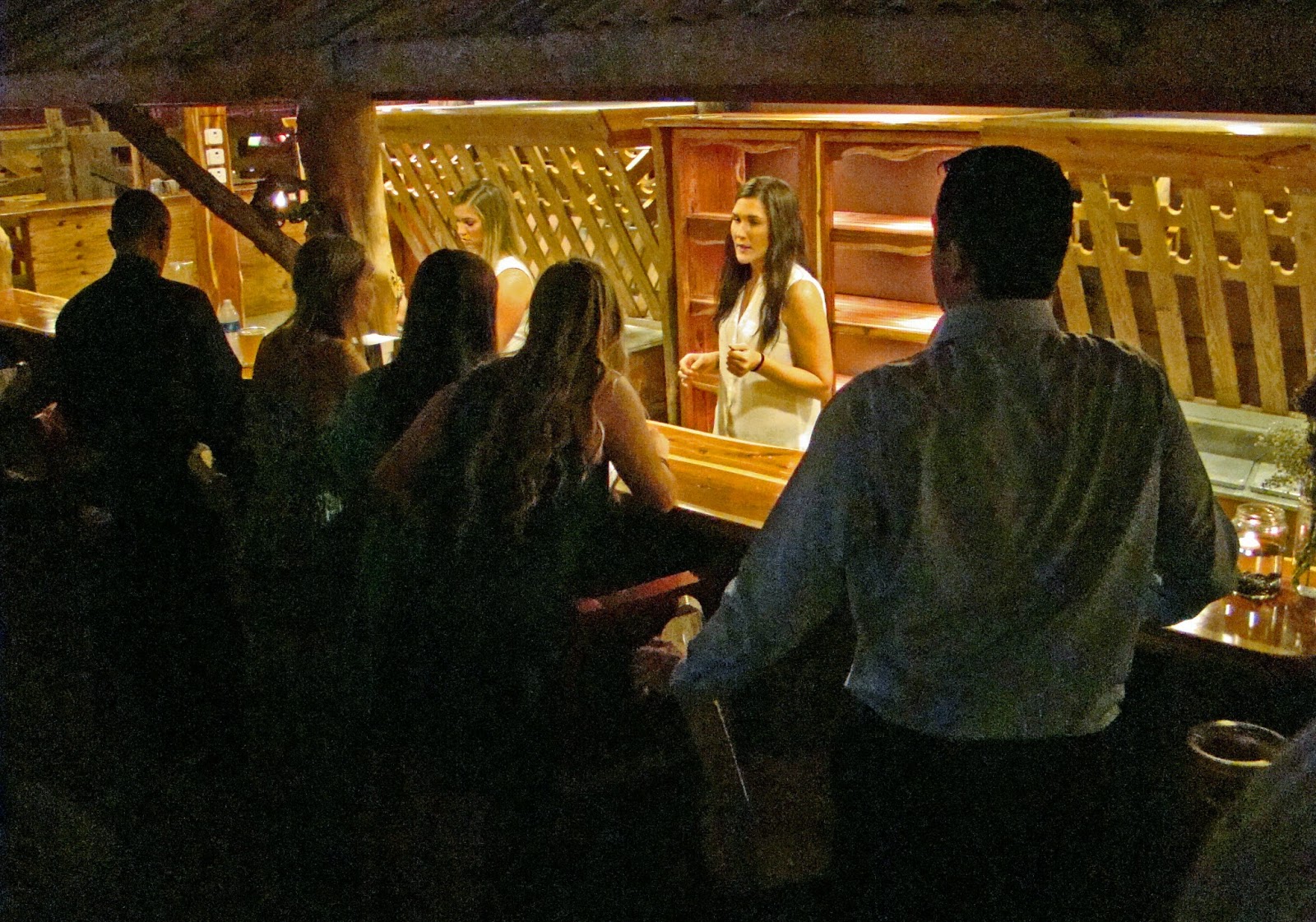
Carved cedar tree trunks hold up a timber framework which shines under the tin ceiling. The cozy lighting makes each area intimate, even though it is a huge (16,392 sq ft!) facility. A large stage will facilitate most bands, who will appreciate the excellent sound system, and there is a spacious serving room for caterers.
Here are a few shots of a beautiful wedding for the Prescotts, held there Saturday...
There was room for three hundred people to dine afterwards...
And just as many to dance.... after the wedding chapel was cleared!
This place is sure to become Party Central for the Brazos Valley!
An 80 foot bar... You have to see it to believe it...
And over-the-top ranch decor... a Texan Valhalla!
This Brazos Valley event hall should be called VALHALLA!
Michael Havens can be reached at: (936) 499-8699
Carved cedar tree trunks hold up a timber framework which shines under the tin ceiling. The cozy lighting makes each area intimate, even though it is a huge (16,392 sq ft!) facility. A large stage will facilitate most bands, who will appreciate the excellent sound system, and there is a spacious serving room for caterers.
Here are a few shots of a beautiful wedding for the Prescotts, held there Saturday...
Bridesmaids wait their turn...
The pastor had a lot to say to the couple... about being servants to one another...
If you don't like wood... you'll HATE this place!
This place is sure to become Party Central for the Brazos Valley!
An 80 foot bar... You have to see it to believe it...
And over-the-top ranch decor... a Texan Valhalla!
This Brazos Valley event hall should be called VALHALLA!
Michael Havens can be reached at: (936) 499-8699
Tuesday, June 24, 2014
The P. A. Smith Hotel- A Grand Possibility
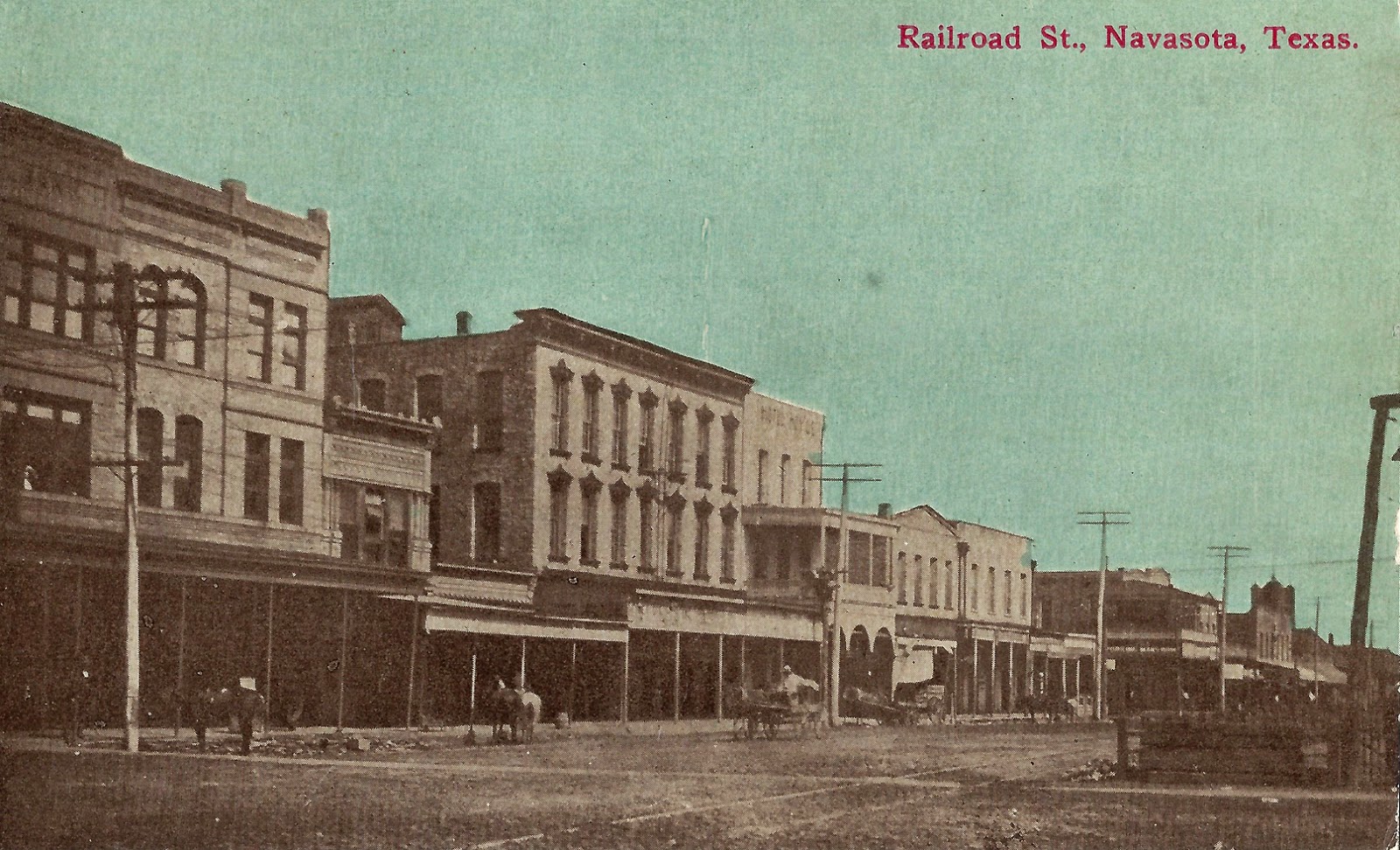
Three stories high and double-wide, the P. A. Smith Hotel was centered in the middle of the "Railroad Street Strande." This was a post card from around 1900. LEFT CLICK on the images to bring them up larger.
P. A. Smith Hotel- 111 Railroad St., Navasota, Texas
After the
town of Navasota was located and surveyed by 1854, the tracks brought the railroad by
1859. The Houston & Texas
Central Railroad had arranged for the budding village to accommodate the rails, and
soon entrepreneurs were setting up tents and building permanent “rock houses.”
One of the first of such buildings was a hotel where Noto’s stands today, built by Mrs.
Louisa Loftin. It was probably completed by 1860 or 1861, (another source says 1864)
either way just in time to suffer the effects of a crashing economy due to the
Civil War…
Mrs. Louisa Loftin was a apparently a widow and one of the first residents of Navasota,
and apparently had considerable ambition for a woman in those days, aiming to
give the other hotels in town a run for the money. She hired J.
W. Peterson to build her hotel and soon J. H. Stacey was hired to build a row of rock houses along Railroad
Street, which became the center of activity. Structures were erected for Loftin & Fisher, John K. White, R. H. Giesel
(also spelled Geisal & Geisel), and A. J. Hall.
Philip Aurene "P. A." Smith was a New York born, Illinois schoolteacher,
who was a personal friend of Abraham
Lincoln. When the War Between the States
broke out, he had sympathies with the South and joined the Confederate army,
serving in Parson’s Partisan Rangers. As a Yankee “Copperhead” Smith was
obviously an independent thinker, having rejected the persuasions of his Republican
friend and president. After serving in the cavalry in Texas he ended up
in Navasota by 1869, where he purchased the silent presses of the "Texas Baptist" in Anderson, and established the Navasota Weekly Tablet. Later he bought out widow Lancaster's interests in her husband's newspaper, The Texas Ranger. Smith also owned a furniture store, a cotton
business and invested in Real Estate.
Besides being a devoted Democrat and journalist, P. A. Smith also built and
managed the Navasota Opera House, which stood where the City parking lot at the intersection of Farquhar and Washington are today. .
Around 1900
After
building up her trade for several years, Mrs. Loftin started a larger project
on neighboring lots 5 and 6 of Railroad Street. Around this time she married P. A. Smith, a man with considerable abilities and designs himself, in 1875. As they joined visions a huge edifice was
erected on these lots, constructed by men known to us as Misters Wiley and Riley. Built of native sandstone (rubble: not quarried), the name was changed to P. A. Smith
Hotel, as the new Mrs. Smith graciously allowed his name to be put on the
business. Some sort of trade must have been agreed upon, as (the carpenter?) John Wiley was given a permanent residence on the third floor, from the very beginning of the hotel. This towering stone landmark, which became the centerpiece of downtown Navasota, was finished in 1876, and turned out to be the grandest
structure ever built in town, only eclipsed recently by the reconstruction of
the old 1903 City Hall.
The Hotel
only served as such for a little over a decade, then after Mrs. Smith died in
1890 the upstairs became the Smith family residence for many years. P. A. Smith died at age 74 of typhoid fever in 1903. In 1944 it
was conveyed to Mr. Martin Allen. He
sold it to Eddie Conally/Coneley?, who
eventually deeded it to the Grimes
County Historical Survey Committee in 1974, placing it in the fickle hands of the Grimes County Historical Society.
The GCHSC had
high hopes and major plans to restore and utilize the P. A. Smith Hotel as a
community cultural center with historical exhibits and events. P. A. Smith Hotel Restoration, Inc. was incorporated and became the official manager of the project, led by Gene Bouliane.
They also knew how to organize and more importantly, how to raise money. Impressive corporate and private funds were donated, with a major gift made by a local bank ($6,000) and also an undisclosed amount by Mr. Gene Bouliane, and receipt of matching Texas Historical Commission and Federal ($22,500) grants, and a local bank loaned $32,000 for interim financing, putting way over $60,000.00 in improvements into the property. I know all of this because my father, Ralph B. Cushman Jr., was the contractor hired to oversee the restoration, and I inherited much of the papers he compiled as the contractor and as a board member.
Demolition, architectural and engineering studies ate up some of the funds, then much the stone was re-chinked, windows rebuilt and the roof repaired, until funds began to dwindle. The project proved to be a massive undertaking, and since no work had been done on the building in decades, the neglect had created hundreds of lurking money pits. The "Histerical" folks began to be impatient, anxious to see a functioning facility...
Illustration from P. A. Smith restoration project
They also knew how to organize and more importantly, how to raise money. Impressive corporate and private funds were donated, with a major gift made by a local bank ($6,000) and also an undisclosed amount by Mr. Gene Bouliane, and receipt of matching Texas Historical Commission and Federal ($22,500) grants, and a local bank loaned $32,000 for interim financing, putting way over $60,000.00 in improvements into the property. I know all of this because my father, Ralph B. Cushman Jr., was the contractor hired to oversee the restoration, and I inherited much of the papers he compiled as the contractor and as a board member.
Demolition, architectural and engineering studies ate up some of the funds, then much the stone was re-chinked, windows rebuilt and the roof repaired, until funds began to dwindle. The project proved to be a massive undertaking, and since no work had been done on the building in decades, the neglect had created hundreds of lurking money pits. The "Histerical" folks began to be impatient, anxious to see a functioning facility...
Sadly, after
the enthusiasm about the American Bi-Centennial
waned after 1976, so did the interest in the hotel. Small town politics began to
raise its ugly head, as many of the movers of this project were newcomers. It was obvious a new breed was moving in, shaping the town, making lasting contributions and commitments. But in short order
the dreamers, donors and volunteers were disposed of, in various ways, mostly just plain ingratitude and insolence, and the membership remaining after the purging abruptly changed
their mind.
I don’t know exactly when, but around 1979 the hotel was sold off, at a loss to Mr. and Mrs. Urquhart, and the proceeds from the liquidation divided and used to fund the Grimes County Historical Commission, (a county-focused historical and preservation information organization) and to jump start a new organization- the Grimes County Heritage Association, led by Georgia Best, (formerly secretary of the P. A. Smith Hotel Restoration Inc. ) which immediately moved into the newly donated R. A. Horlock house on East Washington Street…
I do not know the exact number, but most parties involved agreed that the purchase price for the P. A. Smith Hotel was less than that spent on its restoration, somewhere in the neighborhood of $50,000.00. The Urquharts later sold the building to Dean Arnold who has maintained and used the old hotel for a wood-working factory for a couple of decades.
And now, it
is abandoned and for sale again, along with two other buildings on Railroad Street. Such a disappointing reality for the highest hopes of the Smiths, the
Grimes County Historical Committee and the Arnolds, all of whom toiled with
good faith and no small amount of investment…
Still, I
have to believe the right folks have not owned it yet. So far a couple of
serious investors have looked at it and loved its possibilities, but ran into a
wall of non-cooperation with the City over establishing a railroad quiet-zone. Ironically, the same industry which brought
the old hotel to Navasota, now retards its future.
Wednesday, June 18, 2014
Sgt Dibbrell Led Half a Ranger Company [eventually] to Tame Navasota!
Captain John H. Rogers and Sergeant John Dibbrell, of Co. C, Texas Rangers
One of the
Texas Rangers who was
sent to fight the criminal gangs waging private wars in Navasota was Sergeant John Dibbrell of Company C, then
based in Alpine. Things must have been quiet out in west Texas,
where towns are far apart and few people were found in between, and in 1907 the
Rangers sent Dibbrell and a new private to Navasota when the violence there grew
to amazing proportions for such a civilized portion of the state.
So one day
two Texas Rangers showed up, fresh from the Wild West, and started knocking
heads in the muddy cotton center of the Brazos Valley. Dibbrell, like many
rangers before him, effectively quelled the nonsense for a season, and used the
adventure to break in his lanky sidekick, a 23 year-old kid named Frank Hamer.
Young Hamer
showed great promise as a ranger, and he and Dibbrell made a positive
impression on the law-abiding citizens of Navasota. But as was typical for the
rangers, as soon as things quieted down, they scooted out before they could get
entangled in small town politics - or get offered permanent jobs.
They kicked the dust off of their feet and headed back out into “the great wide
open.” What a difference there was between west Texas and east Texas.
In a few months,
a deadly killer named Ed Putnam holed
up in a home in Del Rio after a witness saw him murder a local sheepman. Well-armed
and desperate, he asked for no mercy and gave none. Captain John H. Rogers and Privates Hamer and Hudson and one other ranger surrounded the house and a hot gunfight
exploded for almost an hour. When it was over, the rangers counted over three
hundred bullet holes in the walls of the humble abode, and learned that Private
Hamer had ended the fight with one well placed Winchester bullet in Putnam’s
head. This was the second outlaw Hamer had killed in a shoot out. Frank Hamer
was the man you wanted next to you in a tight spot. He suddenly began to make a
name for himself in the community.
Soon the
violence kicked up again in Navasota, worse than ever, and the Navasota City Council
saw Marshal W. B. Loftin leave in fear and disgust, after getting a finger shot off.
Nobody else wanted the job, and the few men foolish enough to have taken it in the past did
not last very long. The City was wide open, the Republicans and Democrats were
in an all out shooting war, and armed white gangs brutalized and lynched blacks
and killed each other over turf. Finally the mayor contacted the governor,
pleading for assistance from the Texas Rangers. The councilmen were convinced they needed a
permanent ranger. The governor was quite aware of the troubles in Navasota, and
agreed that only a ranger would do. He made a call.
Soon after, Ranger
Headquarters in Austin asked Sergeant Dibbrell if he wanted the job, as, unlike
so many city marshals, he had been successful there. He had done magic in Navasota
before, so he might be the man for the job. Would he leave the clean mountain
air of Alpine and trade it for a plantation-bottom river town? Dibbrell was
incredulous. He was not interested even though the job would mean a
considerable increase in salary. But Dibbrell offered a solution. He
recommended Private Hamer. You can almost see the dusty room in Alpine, full of
boots and spurs rangers kicking around the governor’s request, and Dibbrell smirking
as he handed the letter to Frank Hamer. You can see the empty look on Captain
Rogers’ face, concerned that he was about to lose his finest recruit ever… And
you can imagine the young man’s starry outlook, anticipating a cushy job with
better pay.
Looking
back, we have to acknowledge Ranger Dibbrell’s wisdom. He knew how to pick ‘em.
But at first the Navasota City Council was unconvinced. Private Hamer was too
young and inexperienced. They did not
want a trigger-happy Billy the Kid-type terrorizing the town. But Dibbrell stuck to his original rejection
of the job, and insisted that Hamer could handle it. Eventually, desperately,
the people of Navasota adjusted to the idea. The “powers that were” thought a
young ranger would be perfect, as they could easily intimidate and boss him.
So Marshal Frank
Hamer reported to duty in Navasota, Texas in November of 1908.
And the rest
is Ranger History.
Friday, May 16, 2014
The Horlock House finally gets the attention it has deserved.
And what a transformation!
The Horlock House has been restored from stem to stern.
The city of Navasota found the funds to refurbish and repurpose the Horlock House on Washington Avenue. If you do not know which house this is, that explains why it was completely stripped and given a new life as artist's apartments and an art gallery.
Architectural elements come alive in the Spartan surroundings.
In an effort to make the house relevant to the community, and further Navasota's arts identity, the Victorian furniture and history exhibits were removed to make room.
The City of Navasota has taken bold steps to artistic glory...
And look what is happening downstairs...
A New Era Begins: The Horlock House as Cultural Center
A SERIOUS art gallery in Navasota, Texas!
The Horlock Gallery is managed by the Arts Council of the Brazos Valley. Art is placed sparingly for effect in this new artist's venue, where each painting is given importance and the space necessary to connect with its viewers without distraction. Mr. Horlock's personally designed tile-fronted fireplace was a great shock to his wife in 1892... Today it fits right in.
The new life of the Horlock House has begun as a contemporary art gallery. It is a challenge for artists to create works which can stand alone and compete with the fetching surroundings... but there are now three artists living in the house determined to try.
A painting awaits placement in the newest and most exquisite art gallery in the Brazos Valley.
There will be a viewing of the art (and the house!) on May 17 between 5:30 and 8:00. Brace yourself for a shock- at the beauty of the old Victorian house now that it has been painstakingly restored. And at the quietly stunning surrounding it supplies for the art...
Artists live and work upstairs and display their works downstairs. Each door beckons the visitor to enter into another different exhibit.
It's no Taj Mahal... but for emerging artists this may be a unique opportunity to get away from their ruts or distractions and live in and with their work, and to meet the public and other artists and observe reactions to what they are doing.
Great things have small beginnings...
Tuesday, December 17, 2013
Jeff Milton: An Odoriferous Legend
Jeff
Milton’s story is an extraordinary one. One of the most famous lawmen
of the west, he was the subject of J. Evetts Haley’s A Good Man With A Gun. Born the son of the Governor of Florida, Jeff
Milton became a Texas Ranger and served in various capacities throughout the American
West, his legend stretching over three states. But like many mythic figures of our past, that legend was carefully crafted by his biographer and is in bad need of an overhaul. I did not arrive at the conclusion which I would have preferred, that of hailing another famous ranger from Navasota. I'm far from convinced that Jeff Milton was a "good" man, although he may have been a man good with a gun. After tackling his biography by Haley, I can't get a bothersome smell out of my nostrils...
Jefferson Davis Milton was born at the outbreak of the Civil War, the son of privilege on a Southern plantation. His father, Governor John Milton, refused to accept the failure of the Confederate States of America and took his own life. Little Jeff was raised by his mother and doting big sisters, and it is easy to imagine his character traits given these circumstances. By the time he was fifteen, he was spoiled, arrogant and restless, with a great deal to prove to himself. His mother could not handle him, and one of his sisters thought she could, given a better environment in Texas.
He came to Texas in 1877 as a teenager, eager to see and experience all the wild and woolly West he had read about in dime novels. This was the land Davy Crockett had died for at the Alamo, and where Texas Ranger Bigfoot Wallace had fought the Comanches; Where buffalo still ran wild and cowboys lived free on the American plains.
Jeff’s
sisters had migrated to Texas after the war and Fannie Milton
had married Colonel James Quincy
Yarborough, a Texas merchant who was building a small retail empire in
Grimes County. As a partner in Wilson and Yarborough, he had
established several mercantiles in Grimes County. So it was the hope and
prosperity there, and the promise of change which lured Jeff halfway across the
country. He would join the Yarboroughs in Grimes County and hopefully see some
“greener pastures” and live the life of a westerner.
Just sixteen, Jeff Milton entered Texas like a blank canvas with visions of grandeur. He was pleased when Colonel Yarborough handed him his first cigar and loved what it symbolized. He was being accepted as a man. He could not have asked for a better situation, a fresher start, or a more thrilling prospect. But soon Jeff would realize that it was not a home or retail business which made him feel complete. Hauling sacks of corn or sweeping out one of his brother-in-law’s stores seemed too mundane for the son of a governor. Jeff had always heard about Texas, but this was not it.
Colonel Yarborough
eventually co-owned four stores, including one in Anderson, the County Seat , and one
in Navasota, the largest store in town. There was plenty of excitement in the
gambling halls and saloons down the street, but there was also plenty of work to do, and Jeff was not allowed to go
there. And there was a predictability and
jadedness that repulsed him in such places, as they reminded him too much of Florida.
Overall, these towns were all fairly civilized places and Jeff was seeking
a proving ground… and vindication of sorts.
Just a baby during the war, he had missed out on “forging his own mettle” during the War Between the States, and his father had died shamefully. Every young man needed a way to establish his manhood, and establish his own name. He thought he would not be satisfied until he was a cowboy, living on the range, facing adventure or Indians out west, or some kind of adversary where he could display his Southern fire.
Then one day
two bookkeepers, Billy Barry and Ben Calhoun left the employ of Colonel
Yarborough. According to Haley, Billy’s "Uncle Buck" (Lt. Col. Buck Barry, CSA?) had made a name for himself as a ranger and Indian
fighter during the Civil War, and Billy felt some kind of itch that only northwest Texas could scratch. They
took their earnings and headed west, to join a fellow accountant, "Pete" ("Pink") Hatchett ( a newcomer to Grimes County, Captain Pinkney Gilliard Hatchett of Georgia, who had recently taken a job as a schoolteacher in Anderson) in
starting up a ranch on the “Clear Fork” of the Brazos, wherever that was. Hatchett planned to raise Texas cattle there and drive them north to Abilene, Kansas to sell them. Maybe
someday if Jeff got bored around Navasota, he would come up and join them… For
Jeff, this development became the proverbial seed of discontent. These three Grimes County men
abandoned their desk jobs and did what he dreamed of. They put on their boots and hats and headed west and named their outfit the “Saw-Horned
Cattle Company.” Veritable geniuses,
it was obvious they planned to simplify a step in cattle management, by just
nipping the horns of their long-horned cattle, rather than branding them. Just a baby during the war, he had missed out on “forging his own mettle” during the War Between the States, and his father had died shamefully. Every young man needed a way to establish his manhood, and establish his own name. He thought he would not be satisfied until he was a cowboy, living on the range, facing adventure or Indians out west, or some kind of adversary where he could display his Southern fire.
Georgian "Pink" Hatchett was a schoolteacher in Grimes County after the Civil War, before heading west to start a cattle operation called the Saw-Horned Cattle Company. He drove several herds up the Chisholm Trail to Abilene, Kansas before returning to Navasota and selling kerosene around town from a wagon.
[Note: I can find no close kinship between William "Billy" Barry of Grimes County and Buck Barry, the famous Texas Ranger, and the son of Bryant Buckner and Mary Murill Barry. He apparently arrived Texas in 1841 and originally settled outside of Corsicana. Billy Barry, the friend of Milton's, was the son of Confederate veteran W. E. Barry and Martha Meachum Barry. W. E. was the son of Lewis Dickson Barry who came to Grimes County in 1849.]
The magnet of the west for young Jeff was suddenly magnified to an irresistible strength. He began to save back his money to buy himself an "outfit." He would need a good horse, saddle and tack, spurs, lariat and weapons and the leather to hold them.
It turns out this ingenious cattle operation on the Brazos River was in far northwest Texas, 500 miles from home. Comanches and outlaws still ran amok there and dangerous adventure was not just a possibility, it was guaranteed. Soon Jeff bought himself a horse and he and Allen left with little fanfare, and much against his sister’s advice.
Jeff had
already come all the way from Florida. An old muddy river did not sound that
intimidating. Finally they were on their way, rarely to return to the pastoral life in
East Texas. And mile by mile, the West began to unfold. And Jeff Milton began
to set things right... Or so he intended.
The two tenderfoots made
the long trip in 1879 following
the deep sluggish Brazos, until it narrowed and ran pristine between wide open prairies, teeming with wildlife. And sure enough they found their Navasota associates on the High
Plains where streams ran clear and nights were cool. It felt like heaven. So far from home, it was easy to play on the
sympathy of the cattlemen who hired them on. Captain Hatchett ran a tight ship, as if he was still in the Civil War, and every cowboy was treated like a soldier. The ranch was situated a day’s
ride from the old Fort Phantom Hill. It was the nearest remnant of
civilization, and it was abandoned and in ruins. The ranch house was really
more like a badger hole. Literally a “dugout” made of logs and mud. But the west was changing fast. The buffalo
were being decimated, and the antelope were skittish. Sometimes ranch hands had
to eat turkey, or jack rabbits or prairie dogs, or even snakes. But Jeff was
determined to stick it out.
"Creekbed Christening"
Come that
winter, it got even worse. Captain Hatchett
bunked him in a tent, all by himself, way off in the wilderness to watch his
sizable remuda of horses, which were left to run wild. His job was to keep the “broke” horses from
amalgamating with the mustangs, which ran around tauntingly like kings of the
plains. If he was not yet a prince of the West, never-the-less he got to watch or
even match wits with some. And it was as grand as he ever imagined. THIS was Texas!
Two young cowboys met on the high plains of Texas and became fast friends. Jeff Milton and George Scarborough would work more together handling outlaws rather than cattle.
When Jeff
got to go into Fort Griffin for supplies, he stood shoulder to shoulder with
Army scouts, trail drivers, buffalo skinners, suspicious looking gunslingers
and Texas Rangers. This had been the proving ground for Wyatt Earp, Bat Masterson, Billy Dixon and many others. He saw the outlaw John Selman. He met the dashing young
George Scarborough, a future legend in law enforcement whom he would often team
up with. He witnessed a shootout between two buffalo hunters, so close that
when one shot the other’s brains out, Jeff caught the explosion of body fluids
as he tried to stop them. THIS was Texas. Here he was Jeff Milton, man among
men, even if he was only seventeen. Here life was measured by each breath, and your
reputation was as infinite as the Llano Estacado.
It was early to bed and early to rise for this son of privilege... but he adapted to it with amazing determination.
In the
spring after round-up, he and Allen Morrison decided to mosey back home to Grimes County and
enjoy a few creature comforts. But they had blown their earnings before they
ever got home. So Jeff took a job as a guard on a prison farm near Huntsville…
maybe he would get a shot at John Wesley Hardin, the famous Texas gunslinger
who now resided inside the walls. But the Huntsville Prison cotton plantation
was in practice and principle everything he hated about Florida. All Jeff could
think about was what he might be missing out west. He made himself a modest “grubstake”
and quit his life as a “straw boss.” He had to do better than this.
When Jeff
finally came home to Navasota, his pocket was full of money and his heart was
won over. Cowboying was tough. But the West was his first love. He put his
money in the bank one Saturday in Navasota and began to stroll around like a
man with a purpose. He just had not identified it yet. It is no doubt that he
began to think about the gallant yet unpretentious Rangers he saw on patrol in
west Texas. They seemed to embody everything he wanted to be. But he had never
thought about being a lawman… at least not until his choices were made clearer.
Then that
next mundane Monday morning came along. Jeff could never know how important the
next few moments would be in his life. He went to go cash a check… just to see
how it all worked. You put your money in
the bank, and then you draw it out as you need it. This sounded fairly
uncomplicated. But when he got to the bank, he ran into a wall more arresting
than one of those cold “blue northers” he had endured on the plains. A sign
announced, quite matter-of-factly, the bank was closed. Forever. Nobody could make a withdrawal. Ever.
Jeff stood
devastated and angry. He had never trusted anyone with so much money. His
money. Suddenly the sheriff came by and
Jeff told him his problem. Sheriff Dan Wood was sympathetic to the young man
and gave him some unofficial advice. The
sheriff knew which entrance the bankers used, and suggested that Jeff hide
under the rear stairway and wait for them with his check in hand, and demand
satisfaction when they opened their doors.
Sheriff Woods then made himself scarce and stood back to watch the
fireworks, kind of like something Andy Griffith would do. This was the way the Law operated in Navasota
in those days.
And Jeff was
game. He did just as suggested. The bankers probably saw him as a person of no
consequence, just old Colonel Yarborough’s young brother-in-law. Certainly no
threat to them, whatever his claims. They had much bigger problems on their
minds… as they unlocked the back doors. Jeff presented his check, and his
intention of getting his money out. The
bankers shook their heads and shrugged, as they heard his request. It was impossible. If they paid him they would have to pay everybody...
But Jeff made a telltale move at that point. He
pulled out his six-shooter and demanded all of his money. Technically, at this
point he was robbing the bank. But quickly, amazingly, Sheriff Wood sauntered
in and backed him up. Jeff explained nonchalantly that the men were cashing a
check for him… which was true, albeit by gunpoint. Sheriff Wood must have reasoned that a man
had a right to demand his own money, using a gun or not. The bankers saw they would get
no help from Wood so they somehow satisfied Jeff, probably out of their own
pockets. Jeff got his money and, soon to become the toast at every bar, he soon
got out of town.
This was not the kind of reputation he had wanted. It was obvious to him and anyone paying attention that his six-shooter had become an extension of his temper. Jeff suddenly knew he had to find a legitimate expression for this propensity, or things could get ugly. About this time he heard that Major John B. Jones in Austin was recruiting good men with shooting skills to join the Texas Rangers. Jeff knew exactly what he had to do. He was too young to join... but he might be able to swing it if he played his cards right. He asked one last favor of his brother-in-law. For his plan to work, he had to let somebody else do his bidding for him. He convinced Colonel Yarborough to write him a letter of recommendation, and his friend, the former Attorney General of Texas, and Civil War hero, H. H. Boone, as well. Even young and naïve, Jeff still understood the world of his father, of politics and influence, and he used it shamelessly. After all, he did not want to go down in Navasota, robbing his own bank. Next time things might not go his way.
Suddenly within a few weeks, Jeff had gone from taking a few bucks at gunpoint from unsuspecting bankers, to swearing an oath to uphold the laws of the State of Texas. You gotta love this country! Where else could men find their hearts and shape their destinies and carve out their legacies in such amazing twists and turns of events?
Jeff Milton only served on the Texas Ranger Force for around three years. Within his first year, he had to kill a violent, belligerent, drunken troublemaker in Colorado City. A popular cattleman, the victim had been enraged over being chained to a tree during a previous altercation. Three Rangers tried to disarm two mad drunks and when one of them fired at one of them, Jeff immediately plugged him. This was an explainable shooting in the line-of-duty, but Jeff was prosecuted for it. The townspeople insisted that Jeff had killed the man unnecessarily. Once again Jeff called upon the powerful services of his friend in Navasota, H. H. Boone, who got him off but managed to get the whole Frontier Ranger Battalion dismissed in a cloud of legal questions in the process. Even more ominously, if not downright smelly, the star witness for the State, Ab J. Adair, who had repeatedly demonstrated his fear to appear in court to testify, was found shot dead the morning he was supposed to testify. All this trouble, and Jeff was still not old enough to even be a Texas Ranger.
After acquittal in 1883, it is not surprising that Jeff left the Force and returned to store keeping in Ft. Davis, and later Murphyville, far southwest Texas. In a short time he had gone into the saloon business and almost immediately pulled his gun on a customer with intent to kill, over the wanton destruction... of a shot glass. Worse than that, his target was a member of the famous Kokernot ranching dynasty. He quickly divested himself of that tempting situation, but then ended up shooting at and hog-tying his barber one day during a haircut, after he became suspicious of the barber's razor. He thought the barber was crazy... Haley wrote that young Milton had the man committed to an institution... But this sounds like the beginning of Milton's larger than life self-aggrandizement, which Haley respectfully treated as the gospel.
Unfortunately, I have found so many discrepancies in names and relationships in just the launching of this legend, that I have learned to treat Haley's biography with a grain of salt.
Not surprisingly, once again Jeff Milton felt the "call of the horizon," which had lured him from Florida, Navasota, and his budding law enforcement career. Jeff, born to be wild Milton was quickly becoming a fugitive from society and himself, and would be on the run the rest of his life, trying to find that legitimate expression of his trigger finger. He soon struck out for New Mexico, and another fresh start... and he was only 22 years old.
Jeff Milton would return to the Brazos Valley of Texas many years later around 1900, still recovering from a shoot-out he had with train robbers. In a suspicious coincidence, Milton found himself waiting inside a Wells Fargo express car, right as some dull-witted robbers tried to hijack the contents. He prevented the robbery and plugged some of the outlaws, but paid a terrible price for his stand. He was shot and left for dead by the gang who left him and the money, and he lost the use of his arm.
Middle-aged and badly crippled, Jeff decided to look for an easier gig. Uncharacteristically, he headed east, back home to Grimes County and the loving care of his family. After recovering from the shooting, he showed up in Navasota with a surprising scheme, his one good arm toting a briefcase full of cash from the Wells Fargo reward and a block of land leases in Walker County. Although disinformation placed it elsewhere, records showed that drilling began in 1901 in "Macedonia," known today as Mustang Prairie. Dead-eyed and dry as an uprooted prickly pear, Jeff Milton was no longer the bright-eyed gent looking for adventure. He was in fact an over-the-hill hired gunman who had faced loaded guns and death too many times to count. And rarely had he enjoyed the appreciation of the local population. He had to have become a bit cynical about lofty ideals such as Justice or the "Rule of Law." He was now just hunting cold hard cash.
Jeff Milton suddenly appeared in Navasota as an oilfield investor and driller, coming to harvest oil reserves he once suspected in nearby Walker County... A place not famous as an oilfield. Being from the area, this return and its suspicious explanation made me begin to wonder what he was really doing back home, except trying to recover from his injuries and take advantage of his sister's hospitality. The hair-brained drilling scheme turned out much like one would expect, and after a year of drilling, his well ended at 800 feet. It was assumed the reward for his famous Wells Fargo robbery intervention had gone down an endless hole... but surely this old desert fox had not suddenly become a rainbow chaser... spending his hard earned cash reward on a lark...
Simultaneously, (coincidentally?) the White Man's Union of Grimes County initiated the most successful, violent drive against the racial and social reorganization of Reconstruction ever seen, using terrorism, racial cleansing, and assassination. As a result, as many as ten black officials were dead, and the Populist County Sheriff Garrett Scott had been shot and escorted out, never to return. And at about the same time, Jeff Milton rode out with a beautiful, brand new saddle from Rodes and Owen, of Navasota, Texas (see photo above).
After travelling all over the southwest, and his ranging days over, it seems strange that he would acquire such a saddle in Navasota, at the time when he was rarely on a horse. It has every appearance of being a token of someone's esteem... perhaps a bonus, if you will, for unspoken favors.
Hundreds of defendants, the most prominent businessmen in the county, were named as accomplices to Sheriff Scott's assassination attempt, in a sham trial in Galveston, including the sons of Milton's benefactors in Navasota, but the "good man with the gun" was not one of them. We will never know the details... but I suspect that he might have thrown his weight into family interests and paid off some old debts with in-kind services. And this would not be a surprise given the thinly disguised racial views expressed in his biography.
Still, Milton was once quoted as saying, "I never killed a man that didn't need killing; I never shot an animal except for meat."
And after reading Haley's account, I understand why Jeff Milton left the Texas Rangers so quickly. Navasota's beloved H. H. Boone not only conspired to get an under-aged trigger-happy youth into the much-maligned organization, but after his herculean defense at the murder trial, the State of Texas did not even know what or who the Rangers were! The law was as clear as mud as to responsibility, and the whole ranger organization had to be codified and reorganized. That would leave a bad taste in anyone's mouth... and that, to his credit, was Jeff Milton's legacy, especially for those outside the law. Statutory, Natural, Moral, whichever Law Jeff felt strongly about at the time...
You can read the rest of the legend in Haley’s book, a standard of Western Literature, if you can find it. Haley was the curator at the Panhandle-Plains Museum in Canyon, Texas and got to know Milton in his later years. Although I think his book is somewhat of a whitewash of Milton and his career, with a generous layer of gloss, it is worth the read. As the early bank episode suggests, Jeff Milton was not quite the Southern cavalier that Haley created in his biography, but he was a bigger-than-life, one of kind Western legend, who once called Navasota Home.
Labels:
ben calhoun,
billy barry,
george scarborough,
j. evitts haley,
jeff milton,
navasota,
panhandle plains museum,
rangers,
rodes and owen,
saddle,
saw horned cattle,
texas,
yarborough
Subscribe to:
Posts (Atom)